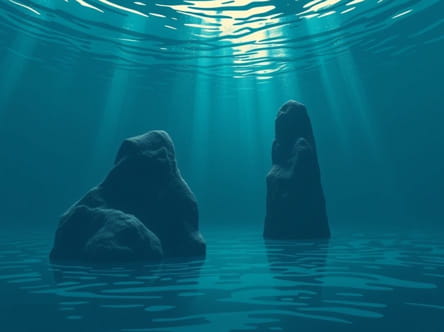
Off the coast of Yonaguni, a small island in the Ryukyu archipelago of Japan, lies a mysterious underwater formation that has stirred debate among archaeologists, geologists, and alternative history researchers for decades. Known widely as the Yonaguni Monument, this massive underwater structure has caught the attention of Graham Hancock, a British author and journalist known for his unconventional theories about ancient civilizations and lost histories. Hancock’s investigation into these Japan underwater megaliths has reignited questions about what we really know about humanity’s distant past.
The Discovery of the Yonaguni Monument
Uncovering a Submerged Enigma
The underwater site near Yonaguni was first discovered in 1986 by local diver Kihachiro Aratake while scouting for dive spots. At a depth of around 25 meters, he came across what appeared to be a series of massive stone steps, terraces, platforms, and smooth walls. The geometric precision of the structure, combined with its scale, led many to speculate that it was not a natural formation but the remnant of a lost civilization, submerged by rising sea levels at the end of the last Ice Age.
Initial Scientific Response
Japanese marine geologist Masaaki Kimura became one of the first academics to seriously study the site. He suggested that the formation had been shaped by both natural processes and human modification, perhaps as far back as 10,000 years ago. However, mainstream geologists generally dismiss the idea that the Yonaguni Monument is man-made, attributing its structure to tectonic activity and erosion patterns found in sandstone formations.
Graham Hancock’s Involvement
Challenging Mainstream Narratives
Graham Hancock has long been known for questioning mainstream archaeological interpretations. In his view, the Yonaguni Monument may be evidence of a highly advanced ancient civilization that predates known history. In his books and documentaries, Hancock presents the idea that this site could be remnants of a culture that thrived before the catastrophic flooding that ended the last Ice Age, around 10,000 BCE.
Underwater Expeditions and Research
Hancock personally dived at Yonaguni and documented his findings in his work. He emphasizes several features that he believes point toward human engineering:
- Perfectly right-angled steps and flat terraces
- Carved channels and what appear to be post holes
- Monolithic structures resembling altars or ceremonial platforms
- Possible carvings on stone surfaces
According to Hancock, such architectural traits are difficult to explain through natural geological activity alone, especially given the site’s scale and detail.
Ancient Civilization Hypothesis
Advanced Cultures Before Recorded History
Hancock argues that humanity may have achieved a high level of civilization before being wiped out by global cataclysms such as floods, earthquakes, or asteroid impacts. He suggests that survivors of these disasters passed on fragments of their knowledge to later societies, giving rise to myths of sunken lands like Atlantis and Lemuria. Yonaguni, in this theory, would be a rare surviving remnant of such a forgotten world.
Dating the Yonaguni Monument
If the Yonaguni structure was indeed man-made, it would need to date back over 10,000 years, since sea levels have not been low enough to expose the site since then. This date would place it far earlier than any known monumental architecture, challenging the timeline of human development as accepted by conventional archaeology.
Criticism from the Scientific Community
Geological Interpretations
Many geologists argue that the Yonaguni formation is a product of natural fracturing in sedimentary rock. The region is prone to earthquakes, which can cause horizontal and vertical shifts in rock layers. Combined with wave erosion, this could theoretically produce terraces, steps, and sharp angles. Critics argue that human beings tend to see patterns especially right angles and symmetry even when they occur in nature.
Archaeological Caution
Most archaeologists remain skeptical of Hancock’s claims due to the lack of supporting artifacts. No tools, pottery, or bones have been recovered from the site, which would normally help date and verify human presence. Without such evidence, the majority of scholars are hesitant to classify the Yonaguni Monument as a true archaeological site.
The Broader Implications
Redefining Human History?
If the Japan underwater megaliths are proven to be artificial, it would revolutionize our understanding of early human civilization. It would imply that complex societies existed well before the development of writing or the building of the Egyptian pyramids. It could also mean that entire chapters of human history are missing, buried beneath oceans or deserts, awaiting discovery.
A Push for Interdisciplinary Study
Sites like Yonaguni highlight the importance of collaboration between geologists, archaeologists, marine engineers, and even mythologists. Hancock advocates for an open-minded yet scientific approach to ancient mysteries. He believes too many discoveries are dismissed prematurely due to rigid academic orthodoxy and that science should always remain open to questioning and reevaluation.
Public Fascination and Media Attention
Popular Culture Influence
Graham Hancock’s theories, often seen as fringe by academics, have found a large audience through books like Underworld and TV appearances on series such as *Ancient Apocalypse*. The Yonaguni Monument frequently appears in discussions of lost civilizations, ancient aliens, and forgotten knowledge. While such exposure sometimes blends fact with fiction, it has kept public interest alive and led to further diving expeditions and documentaries.
Tourism and Local Interest
Yonaguni has become a popular destination for divers and adventurers interested in underwater archaeology. Local guides offer tours of the site, and it has become a source of pride and mystery for the island community. Even without academic consensus, the monument has become a cultural and scientific landmark in its own right.
The debate over the Japan underwater megaliths, particularly the Yonaguni Monument, is far from settled. Graham Hancock’s involvement has amplified interest in these formations and pushed the boundaries of acceptable historical inquiry. While definitive proof of artificial origin remains elusive, the structure continues to provoke curiosity and wonder. Whether natural or man-made, Yonaguni challenges us to look deeper into the past and consider the possibility that much of human history remains undiscovered, submerged beneath the waves and time itself.