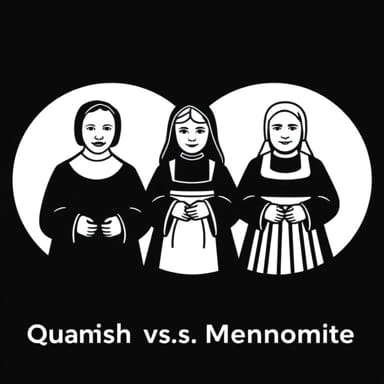
When exploring religious communities that prioritize simplicity, peace, and strong values, the Quakers, Amish, and Mennonites often come to mind. Though all three groups are rooted in Christianity and share certain core beliefs, they are distinct in theology, history, lifestyle, and traditions. Understanding the differences and similarities between the Quakers, Amish, and Mennonites offers insight into their unique contributions to faith and society. Each group represents a fascinating approach to living a life guided by religious principles, often in ways that contrast with mainstream modern culture.
Historical Origins and Foundations
The Quakers
Formally known as the Religious Society of Friends, the Quakers emerged in 17th-century England during a time of religious turmoil. Founded by George Fox in the 1650s, the Quakers emphasized the idea that each individual could experience the ‘Inner Light’ of God without the need for clergy or formal rituals. Their commitment to peace, equality, and simplicity led to persecution, pushing many to emigrate to North America.
The Amish
The Amish trace their roots to the Anabaptist movement of the 16th century in Europe, which rejected infant baptism in favor of adult baptism. In 1693, Jacob Amman led a group that split from the Mennonites, insisting on stricter rules and church discipline. The Amish migrated to North America in the 18th century, seeking religious freedom and separation from worldly influences.
The Mennonites
Also part of the Anabaptist tradition, the Mennonites were founded by Menno Simons, a former Catholic priest, in the 16th century. Like the Amish, they valued nonviolence, simplicity, and community. However, they tended to be more open to interaction with the outside world and more willing to adapt over time, which differentiates them from their Amish counterparts.
Core Beliefs and Religious Practices
Shared Anabaptist Roots
Both the Amish and Mennonites are considered Anabaptists. They believe in:
- Adult baptism by choice
- Separation from the world
- Pacifism and nonviolence
- Community support and mutual aid
Quaker Beliefs
Quakers differ in key ways. Their faith centers around:
- Direct experience of God without clergy or sacraments
- Silent worship, with spontaneous vocal ministry as led by the Spirit
- Strong emphasis on peace, social justice, and equality
- Decision-making through consensus and discernment
Differences in Worship
Quaker worship is often silent, allowing individuals to reflect inwardly and speak only when they feel spiritually moved. Amish and traditional Mennonite worship services are more structured, involving hymns, Bible readings, and sermons. Amish services are usually held in homes, while Mennonite services are in churches. Mennonites may also have Sunday School and youth activities, whereas the Amish generally do not.
Lifestyle and Community Life
Amish Lifestyle
The Amish are known for their rejection of modern technology, plain dress, and horse-drawn buggies. They live in close-knit rural communities and typically avoid electricity, cars, and other conveniences. Their lifestyle reflects a desire to live humbly and maintain separation from the outside world. Amish communities practice mutual aid, support each other in times of need, and prioritize obedience to community rules.
Mennonite Diversity
Mennonites vary widely in lifestyle. Conservative Mennonites may resemble the Amish in their dress and use of technology, while progressive Mennonites might live modern lives similar to mainstream Christians. All Mennonites, however, emphasize service, nonviolence, and community. Many are involved in education, relief work, and peacebuilding around the world.
Quaker Simplicity
Quakers promote simplicity, but they do not shun technology. Their approach to lifestyle is more about ethical choices buying fair-trade goods, avoiding waste, and living sustainably. They often live in urban or suburban areas and engage in social causes, education, and activism. Quaker meetings are typically open to all and can be very inclusive of diverse beliefs.
Education and Work
Amish Education
Amish children typically attend school only until the 8th grade, in one-room schoolhouses run by the community. Higher education is not pursued, as it is considered unnecessary for their agrarian lifestyle. Vocational skills and moral teachings are passed down through the family and church.
Mennonite Education
Mennonites value education and often operate private schools. Many Mennonites attend college, including Mennonite colleges and universities. Education is seen as a way to serve others more effectively and live out Christian values in various professions.
Quaker Education
Quakers have a long tradition of supporting education and operate many prestigious schools and colleges. Education is viewed as a vital tool for social justice and spiritual development. Quakers believe in fostering critical thinking, inner guidance, and personal responsibility through learning.
Dress and Appearance
Plain Dress among the Amish
Amish clothing is plain, functional, and designed to avoid vanity. Men wear dark trousers, suspenders, and broad-brimmed hats, while women wear long dresses, aprons, and bonnets. There is little variation in dress, reflecting unity and humility.
Mennonite Variations
Some conservative Mennonites wear plain dress similar to the Amish. Others dress in modern clothing while maintaining modesty. The range of appearance depends on the subgroup and level of conservatism. Regardless of dress, humility and simplicity remain important values.
Quaker Simplicity in Dress
Quakers historically practiced plain dress, but most modern Quakers dress like the general population. Their approach to clothing emphasizes modesty, ethical choices, and avoidance of excess. Some may choose second-hand clothing or fair-trade garments as a reflection of their values.
Engagement with the World
Amish Separation
The Amish intentionally separate from the outside world to preserve their faith and culture. They do not vote, serve in the military, or participate in public welfare systems. Their communities rely on internal governance and discipline.
Mennonite Outreach
Mennonites are more engaged in the world. Many participate in politics, social programs, and global missions. Mennonite Central Committee is a well-known organization that provides relief, development, and peace efforts worldwide.
Quaker Activism
Quakers are deeply involved in social justice, environmental issues, and peace activism. From abolition to civil rights to climate change, Quakers have historically taken strong moral stands. Their belief in ‘that of God in everyone’ drives their commitment to equality and nonviolence.
Key Similarities and Differences
Similarities
- Commitment to peace and nonviolence
- Emphasis on simplicity and community
- Focus on personal spiritual experience
Differences
- Amish reject most modern technology; Quakers and many Mennonites do not
- Quakers have no clergy; Amish and Mennonites have ordained ministers
- Quakers are highly active in social justice movements; Amish remain apart from political life
- Mennonites occupy a middle ground often modern but maintaining core Anabaptist values
Though they share common themes such as nonviolence, humility, and faith-based living, the Quakers, Amish, and Mennonites express these ideals in different ways. The Amish lead lives of separation and simplicity, the Mennonites blend tradition with engagement, and the Quakers champion inner spiritual guidance and social responsibility. Each group contributes uniquely to the broader Christian landscape and continues to inspire those seeking meaningful, principled ways of living in today’s complex world.
#kebawah#