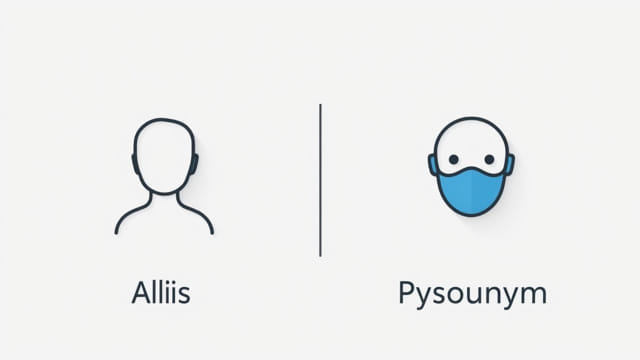
In everyday English, the terms ‘alias’ and ‘pseudonym’ are sometimes used interchangeably, especially when referring to alternative names. However, there are subtle yet important differences between the two. These distinctions are especially relevant in literature, law enforcement, online identity, and even entertainment. To understand the difference between alias and pseudonym, it’s important to examine their definitions, connotations, and typical usage in various contexts. This topic will explore those differences and clarify how each term should be used appropriately depending on the situation.
Understanding the Term ‘Alias’
Definition and Origin
The word ‘alias’ comes from the Latin term meaning ‘otherwise’ or ‘at another time.’ In modern English, it refers to an alternative name a person uses, often to conceal their true identity. The primary connotation of an alias is secrecy or deception, which makes it commonly associated with legal and criminal contexts.
Common Usage of Alias
An alias is typically used when someone wants to hide their real name for specific reasons. It is frequently used in the following scenarios:
- By criminals or fugitives to evade law enforcement.
- In legal documents to indicate someone uses multiple names.
- By undercover agents or spies.
- In historical accounts where individuals used assumed names to carry out secret activities.
For example, a known bank robber might be listed in a police report as ‘John Smith, alias Michael Green.’
Connotations of Alias
Because ‘alias’ is often linked to concealment or criminal intent, it may carry a negative connotation. While not always used in a bad sense, it typically implies that the person is intentionally using a name to obscure their identity for personal or strategic reasons.
Understanding the Term ‘Pseudonym’
Definition and Origin
‘Pseudonym’ is derived from the Greek word ‘pseudonymos,’ meaning ‘false name.’ Unlike an alias, a pseudonym is usually adopted by someone, particularly writers or artists, to create a separate public identity. The use of a pseudonym does not inherently suggest secrecy or dishonesty.
Common Usage of Pseudonym
Pseudonyms are typically used in the creative and professional world, such as:
- Writers publishing under a different name (e.g., Samuel Clemens used the pseudonym Mark Twain).
- Musicians or performers creating stage names (e.g., Stefani Germanotta is known as Lady Gaga).
- Activists or political commentators using pen names for privacy or safety.
- Online creators or influencers maintaining anonymity.
Unlike aliases, pseudonyms are not generally used for illegal or deceptive purposes. Instead, they serve as tools for branding, privacy, or creative freedom.
Connotations of Pseudonym
The term ‘pseudonym’ carries neutral or even positive connotations. It is viewed as a legitimate and common practice in literature, music, and other forms of expression. Many pseudonyms have become more famous than the individuals’ real names.
Key Differences Between Alias and Pseudonym
Intent and Purpose
The most fundamental difference lies in the purpose behind the name change. A pseudonym is typically chosen for professional or artistic reasons, while an alias is often used to hide one’s identity, sometimes for deceptive purposes. The context defines the nature of each term:
- Alias: Usually used to hide one’s real identity, often in legal or criminal settings.
- Pseudonym: Used to create a public identity that differs from the real name, especially in artistic or literary fields.
Legal Implications
Aliases are more likely to appear in legal contexts, such as police records, immigration documents, or witness protection programs. Law enforcement keeps track of aliases to identify individuals who may operate under multiple names. Pseudonyms, on the other hand, are often officially recognized by publishers or copyright offices and can even be legally registered as pen names or trademarks.
Public Perception
Another notable difference between alias and pseudonym lies in how the public perceives each term:
- Aliases are often associated with hiding, trickery, or subversion.
- Pseudonyms are usually viewed as creative choices and are accepted even admired in many professional fields.
For instance, readers usually respect authors who write under pseudonyms, but a news report that says someone was using an alias might raise suspicion.
Overlap and Grey Areas
When Alias and Pseudonym Blur
There are situations where the distinction between alias and pseudonym becomes blurred. For example, an activist in a politically repressive country might use an alias to protect their identity, yet the name also serves as a pseudonym in public writing. Similarly, internet users often adopt usernames that act like both aliases and pseudonyms, depending on context.
Online Identity and Naming
In the digital age, aliases and pseudonyms have expanded beyond traditional definitions. Gamers, streamers, bloggers, and online creators often go by unique usernames or handles that serve both as pseudonyms and aliases. The key to determining the difference is still the purpose:
- If the intent is privacy, performance, or branding, the name is likely a pseudonym.
- If the intent is to avoid detection or mislead, the name may be considered an alias.
Examples to Illustrate the Difference
Example 1: Legal Context
The suspect was known by several aliases, including James Carter and Alex Dean.
This suggests the person intentionally used different names, possibly to deceive or avoid being identified.
Example 2: Artistic Context
The novel was written by Mary Westmacott, a pseudonym of Agatha Christie.
This shows a well-known author used a pen name for creative reasons, not to deceive anyone.
Example 3: Online Usage
He’s known online as TechGuruX,’ a pseudonym he uses for his technology blog.
This indicates the name is used for branding and public persona purposes.
While both ‘alias’ and ‘pseudonym’ refer to alternative names, the difference between them lies primarily in intent, context, and connotation. An alias is often used to obscure a person’s identity, frequently in legal or clandestine situations. A pseudonym, however, is typically used in the creative world for privacy or stylistic reasons and is not inherently secretive or deceptive. Understanding this distinction helps in accurately interpreting the use of names in various fields, whether in law enforcement reports or literary discussions. With the rise of digital communication, the need to differentiate between alias and pseudonym becomes even more relevant for personal branding, privacy, and clarity in communication.