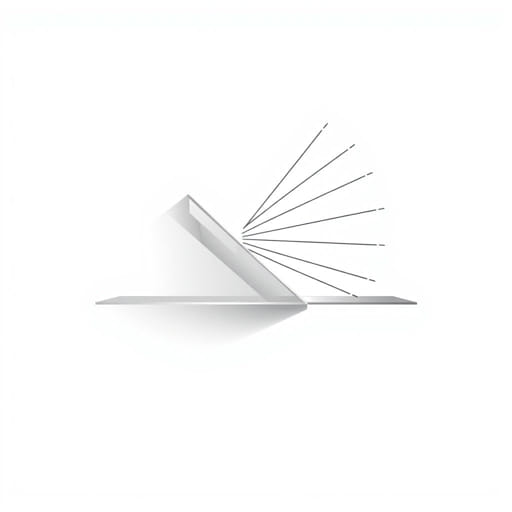
Understanding the behavior of light is fundamental to physics, optics, and many practical applications in our daily lives. Two of the most important phenomena associated with light are reflection and refraction. These processes explain how light interacts with surfaces and different media, shaping everything from the formation of images in mirrors to the bending of light in lenses. Despite being closely related, reflection and refraction have distinct principles, effects, and applications. Appreciating their differences helps in grasping the fundamentals of optics, designing optical instruments, and understanding natural phenomena such as rainbows, mirages, and the sparkle of water bodies.
What is Reflection?
Reflection is the process by which light bounces off a surface and returns into the original medium without passing through the surface. This phenomenon is easily observed in everyday life when we look into mirrors, see the glare of water surfaces, or notice reflections on polished metals. Reflection is governed by the law of reflection, which states that the angle of incidence is equal to the angle of reflection. The incident ray, reflected ray, and the normal to the surface all lie in the same plane.
Types of Reflection
- Specular ReflectionOccurs on smooth surfaces like mirrors or calm water, producing clear images with defined edges.
- Diffuse ReflectionHappens on rough surfaces, scattering light in many directions and preventing the formation of clear images.
Reflection is crucial in various applications, including optical instruments, periscopes, telescopes, and even architectural designs that rely on controlling light. In physics, studying reflection helps explain how light energy is redirected and how optical devices manipulate light paths.
What is Refraction?
Refraction is the bending of light as it passes from one medium to another with a different optical density. This change in direction occurs because the speed of light varies in different materials. For example, light travels slower in water than in air, causing a pencil partially submerged in water to appear bent at the water surface. Refraction is governed by Snell’s law, which relates the angles of incidence and refraction to the refractive indices of the two media. Refraction is responsible for many optical effects, such as the formation of rainbows, lens focusing, and magnification.
Examples of Refraction
- Objects appearing bent or broken in water.
- Lenses in glasses, microscopes, and cameras focusing light to form images.
- Prisms dispersing white light into its constituent colors.
- Atmospheric phenomena like mirages and the apparent position of the sun at sunrise or sunset.
Refraction is essential in optical engineering, vision correction, photography, and the design of scientific instruments. By controlling how light bends, engineers and scientists can manipulate light paths to achieve desired effects.
Key Differences Between Reflection and Refraction
Although both reflection and refraction involve the interaction of light with surfaces, they differ in fundamental ways
1. Nature of Light Interaction
- ReflectionLight bounces back into the original medium.
- RefractionLight passes into a new medium, changing direction due to speed variation.
2. Laws Governing the Phenomena
- ReflectionGoverned by the law of reflection – angle of incidence equals angle of reflection.
- RefractionGoverned by Snell’s law – relationship between angles and refractive indices.
3. Medium Involvement
- ReflectionLight remains in the same medium.
- RefractionLight enters a different medium with a different optical density.
4. Effect on Light Path
- ReflectionNo bending occurs; the direction of light changes along the same plane.
- RefractionLight bends at the interface between two media, changing its trajectory.
5. Visual Outcomes
- ReflectionCan produce clear or diffuse images depending on surface smoothness.
- RefractionCreates apparent bending of objects, magnification, or color dispersion.
Applications of Reflection
Reflection is widely used in daily life and scientific applications. Mirrors in homes, telescopes, and microscopes rely on precise reflection to form clear images. Reflective coatings on vehicles and road signs improve safety by redirecting light. In physics labs, reflection experiments demonstrate fundamental properties of light. Even in art and photography, reflection is exploited for aesthetic effects, enhancing visual depth and symmetry.
Applications of Refraction
Refraction has extensive practical applications. Eyeglasses and contact lenses correct vision by bending light to focus on the retina. Cameras, microscopes, and telescopes use lenses to magnify and resolve images. Optical fibers rely on the principle of total internal reflection, a consequence of refraction, to transmit data over long distances. Refraction also explains natural phenomena such as rainbows, mirages, and the apparent depth of swimming pools, making it vital in both science and everyday experiences.
Combined Use in Optical Devices
Many optical devices utilize both reflection and refraction. Cameras, binoculars, and periscopes employ mirrors for reflection and lenses for refraction to manipulate light efficiently. This combination allows precise image formation, light direction control, and enhanced visual clarity. Understanding the difference between reflection and refraction enables scientists and engineers to design advanced optical systems for medical, industrial, and technological applications.
reflection and refraction are fundamental optical phenomena that govern how light interacts with surfaces and media. Reflection involves the bouncing back of light into the same medium, producing images or scattered light depending on surface characteristics. Refraction involves the bending of light as it passes into a medium with different optical density, leading to apparent displacement, magnification, and color dispersion. Both phenomena are critical in physics, engineering, and daily life, with extensive applications ranging from vision correction and photography to telescopes and optical fibers. Understanding their differences provides a foundation for studying optics and harnessing light for practical and scientific purposes.