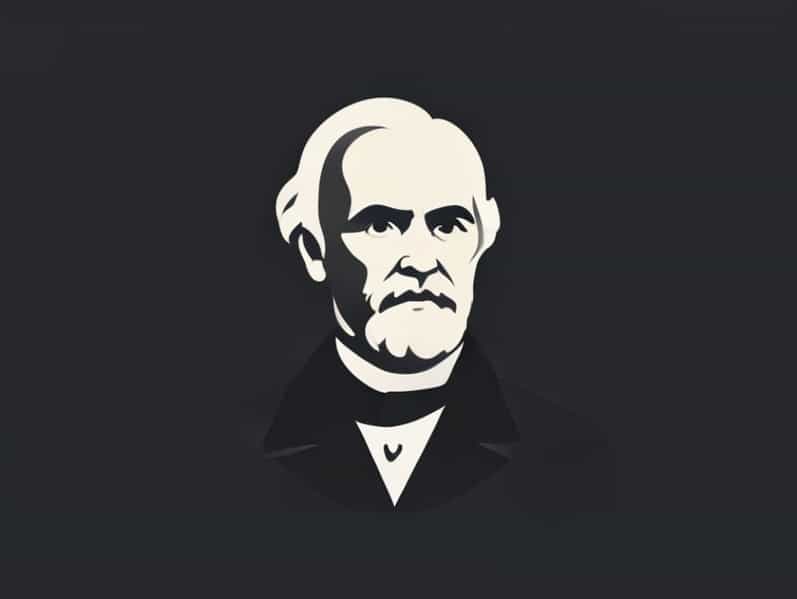
When we think about the foundation of modern computing, the name George Boole often stands out as one of the most influential figures in mathematics and logic. Although he lived in the 19th century, long before the invention of electronic computers, his contributions laid the theoretical groundwork that made computers possible. Through his invention of Boolean algebra, George Boole established a logical system that allows machines to process information in the binary form using 0s and 1s. His work bridged abstract logic and practical computation, influencing not only computer science but also electronics, digital communication, and artificial intelligence.
Early Life and Background
George Boole was born in 1815 in Lincoln, England. Coming from a humble background, Boole was largely self-taught in mathematics and philosophy. Despite not having formal higher education, his intellectual curiosity and self-discipline led him to study advanced subjects like calculus and algebra. He eventually became a professor of mathematics at Queen’s College, Cork, where he published several groundbreaking works that combined mathematics with logic. This unique perspective would later form the basis of digital computation.
The Birth of Boolean Algebra
Boole’s most significant contribution to computer science is his development of Boolean algebra, a system of logic that represents truth values using binary symbols true and false, or numerically, 1 and 0. His ideas were first outlined in his 1847 publicationThe Mathematical Analysis of Logicand further expanded in his 1854 masterpieceAn Investigation of the Laws of Thought. This work introduced a new way to represent logical statements through mathematical symbols, paving the way for modern logical circuits and computer programming languages.
Core Principles of Boolean Algebra
Boolean algebra operates on a few simple yet powerful principles. It involves operations such as AND, OR, and NOT, which can be used to express logical relationships. For instance
- AND (⋅)The result is true only if both conditions are true.
- OR (+)The result is true if at least one condition is true.
- NOT (¬)This reverses the truth value true becomes false and vice versa.
While these operations may appear abstract, they form the core of computer logic. Every decision a computer makes from comparing numbers to executing commands can be broken down into combinations of these basic logical operations.
How Boolean Logic Influenced Computing
George Boole’s system of logic was purely theoretical in his time, but it became the language of machines a century later. In the early 20th century, scientists realized that Boole’s binary logic could be implemented using electrical circuits, which have two states on and off. These correspond perfectly to the Boolean values 1 and 0. This realization transformed Boole’s work from philosophy into a cornerstone of modern technology.
Claude Shannon and the Practical Application
In 1937, American mathematician Claude Shannon made the connection between Boolean algebra and electrical circuit design. In his thesis at MIT, Shannon demonstrated how Boolean expressions could represent the operation of switches and relays in telephone networks. His insight made it possible to design and simplify circuits using logical expressions. Shannon’s work effectively turned Boole’s ideas into the foundation of digital electronics and computer logic design.
Binary Systems and Digital Computation
Every modern computer operates using a binary system that represents information as a series of 0s and 1s. This binary code is directly derived from Boolean algebra. Each bit of data, whether it represents text, sound, or an image, is encoded using combinations of true and false states. Operations within the central processing unit (CPU) are built using logic gates that perform Boolean functions. For example
- AnAND gateoutputs 1 only when both inputs are 1.
- AnOR gateoutputs 1 if at least one input is 1.
- ANOT gateinverts the input value.
By combining these gates, computers perform complex calculations, make decisions, and execute programs. Every modern microprocessor, regardless of size or speed, relies on Boolean logic at its core.
Boolean Logic in Programming and Software
Beyond hardware, Boole’s ideas also play a vital role in programming. In most programming languages, Boolean logic governs conditional statements and decision-making processes. For instance, when a program executes an if statement, it evaluates a Boolean condition whether it is true or false to determine which block of code to run. This allows computers to follow logical reasoning and adapt to different inputs or scenarios.
Examples in Everyday Computing
Boolean logic is everywhere in software and daily computer use. Search engines use Boolean operators to refine results such as using AND, OR, and NOT to filter information. In digital security systems, Boolean conditions determine access rights and authentication protocols. Even machine learning algorithms and data filtering techniques depend on logical comparisons that stem from Boole’s principles.
Impact Beyond Computer Science
Although George Boole’s work is most closely associated with computing, his influence extends far beyond that field. Boolean algebra is essential in areas such as electrical engineering, mathematics, artificial intelligence, and even cognitive science. The binary logic that governs computers also underpins control systems in robotics, automated machinery, and communication networks. Furthermore, Boolean thinking has inspired the development of symbolic logic and modern logical reasoning in philosophy and linguistics.
Legacy and Recognition
George Boole passed away in 1864, long before his work could be applied to technology. However, his legacy endures through every digital device in existence. From smartphones to satellites, all depend on the principles he discovered. Today, Boole is celebrated as a pioneer of the digital age, even though he lived in a pre-electronic era. His combination of mathematical rigor and abstract logic continues to influence computer scientists, engineers, and philosophers around the world.
Educational and Historical Influence
Universities around the world teach Boolean algebra as a fundamental subject in computer science and electrical engineering. Boole’s contributions are also commemorated in research institutions and computer science history. His methodology continues to inspire logical problem-solving and system design an approach that shapes how humans think about computation and reasoning.
The Relevance of Boole’s Work Today
In today’s digital era, George Boole’s logic is more relevant than ever. With the rapid advancement of artificial intelligence, quantum computing, and digital automation, the foundational principles of Boolean algebra remain central. Every algorithm, neural network, and logic-based operation still depends on the binary relationships Boole formalized. His work provides the stability and consistency upon which all complex computing systems are built.
Future Implications
As technology evolves, the influence of Boolean logic continues to expand. Even emerging technologies like quantum computing, which operate on qubits rather than binary bits, rely on Boolean foundations to establish their logical frameworks. Artificial intelligence also employs Boolean reasoning for decision-making processes, logical inference, and data classification. Thus, while Boole’s original concepts were abstract and mathematical, they remain deeply woven into the future of computation.
George Boole’s contribution to computers is not just historical it is foundational. Through his invention of Boolean algebra, he provided the universal language that allows machines to process logic, data, and decisions. His insights bridged mathematics and philosophy, turning logic into a powerful tool for innovation. Every computation, from simple arithmetic to complex artificial intelligence, carries the essence of Boole’s vision. His enduring influence reminds us that the abstract ideas of one brilliant mind can shape the entire course of human technology.