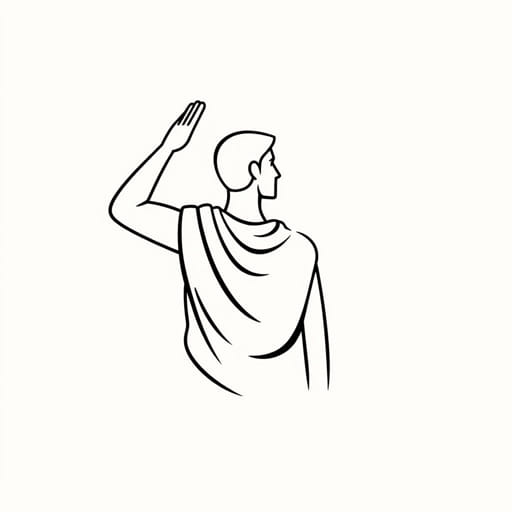
The Roman salute is often associated with the image of a strong arm extended outward, palm down, fingers together, and the arm held at an angle. Popular culture and historical reenactments have romanticized this gesture as a symbol of loyalty, honor, and discipline attributed to ancient Rome. However, it is important to note that there is no solid evidence that ancient Romans actually used this exact salute. Much of what we consider the ‘Roman salute’ today was shaped by art, theater, and modern political movements. Still, understanding how to perform a Roman salute, along with its historical context, symbolism, and implications, is useful for educational, theatrical, or academic purposes.
Origins and Historical Background
Despite its name, the Roman salute does not have confirmed origins in ancient Roman customs. Historical texts and archaeological evidence do not directly support the idea that Roman citizens or soldiers used a specific, formalized hand gesture as a salute. The concept of the Roman salute as we know it emerged from Renaissance-era artwork and 19th-century theatrical performances, where Roman themes were popularized.
One of the earliest visual depictions comes from the 1784 painting ‘The Oath of the Horatii’ by Jacques-Louis David, which shows men raising their arms in a pledge. From there, the gesture was adopted and interpreted as a form of Roman discipline and patriotism, even though it was not based on actual Roman practices.
Modern Usage and Controversy
In the 20th century, the Roman salute became associated with fascist regimes, particularly under Benito Mussolini in Italy and Adolf Hitler in Nazi Germany. This political usage gave the gesture a heavily charged and controversial meaning that continues to affect how it is perceived today. As a result, using the Roman salute in public can be offensive or even illegal in certain countries due to its links to fascist ideology.
Therefore, if you are learning how to Roman salute, it’s essential to understand the context in which you are using it whether for educational, historical, or artistic purposes and to avoid its use in ways that might be considered disrespectful or inflammatory.
How to Perform the Roman Salute
For academic, film, or historical reenactment purposes, the Roman salute can be demonstrated in the following steps. This section provides a practical, non-political guide on how to perform the gesture respectfully.
Step-by-Step Instructions
- Stand upright: Begin by standing straight with both feet flat on the ground and your shoulders relaxed but firm.
- Raise your right arm: Extend your right arm forward and slightly upward. The angle should be approximately 45 degrees from your body.
- Keep your fingers together: All fingers should be extended straight and kept close together. Do not curl or spread them apart.
- Palm facing down: Your palm should face downward toward the ground, not upward or sideways.
- Hold the position briefly: Maintain the salute for a few seconds, then return your arm slowly to your side.
This action is meant to appear firm, disciplined, and respectful. It should not be exaggerated or turned into a theatrical gesture unless required by performance guidelines. The key to the Roman salute lies in its sharp, composed execution that symbolizes order and formality.
Tips for Accuracy
- Use your right arm onlythe Roman salute is traditionally done with the right hand.
- Maintain a neutral expressionon your face to avoid dramatizing the gesture unnecessarily.
- Ensure your postureremains upright and composed throughout the motion.
Appropriate Contexts for the Roman Salute
Because of the gesture’s controversial history, it is important to use the Roman salute in appropriate settings only. These may include:
- Theatrical performances: Historical plays, films, or reenactments set in classical Rome may use the Roman salute to portray loyalty or authority.
- Academic demonstrations: In classrooms or lectures about Roman history or cultural symbolism, the salute can be shown as part of an educational experience.
- Museum exhibits or documentaries: When depicting the artistic interpretations of Roman culture, the salute may be included to demonstrate how modern societies imagined ancient customs.
Outside these contexts, especially in public or political settings, using the Roman salute is not advised and may lead to misunderstanding or legal consequences depending on the region.
Alternatives for Modern Use
If you are looking for a gesture that represents respect or allegiance in a neutral manner, there are several alternatives that avoid the political history associated with the Roman salute:
- Hand over heart: A universally recognized sign of sincerity and loyalty.
- Simple nod: A non-verbal sign of respect that fits most social situations.
- Military-style salute: Used in many modern nations, particularly by armed forces, and generally seen as formal but non-political.
Symbolism Behind the Roman Salute
The Roman salute, as imagined in modern times, carries multiple symbolic meanings. It is often seen as a representation of unity, discipline, and patriotism values that were attributed to ancient Roman society, even if the salute itself was not authentically Roman. Artists and leaders who used the gesture believed it projected strength and devotion to a cause greater than the individual.
However, these symbols became distorted in the 20th century when the gesture was appropriated by totalitarian regimes. For this reason, it’s vital to understand the original artistic and cultural symbolism while acknowledging its later misuse. Historical gestures can be powerful, and their meanings can evolve or be corrupted over time.
Educational Value of the Roman Salute
When used in the right context, the Roman salute serves as an educational tool. It helps spark discussion about the evolution of symbols, the role of propaganda in history, and how artistic interpretations can reshape our understanding of the past. Teaching about the Roman salute within a broader lesson on classical civilization or political symbolism can enhance students’ critical thinking and historical awareness.
Summary of Key Considerations
- The Roman salute is likely a modern invention inspired by classical art, not actual Roman tradition.
- It became popularized in the 19th century and was politically adopted in the 20th century by fascist regimes.
- To perform the salute, raise your right arm at a 45-degree angle with the palm down and fingers together.
- Use this gesture only in academic, theatrical, or controlled environments to avoid misinterpretation.
- Always be aware of the gesture’s historical context and modern associations.
The Roman salute remains a gesture deeply intertwined with both classical imagery and modern controversy. While it may not have authentic roots in ancient Rome, it has become a symbol shaped by art, ideology, and historical reinterpretation. Learning how to Roman salute can offer insights into cultural symbolism, theatrical practices, and the power of visual communication. However, using the gesture responsibly within informed and appropriate contexts is essential to ensuring that history is respected, and misinterpretations are avoided.