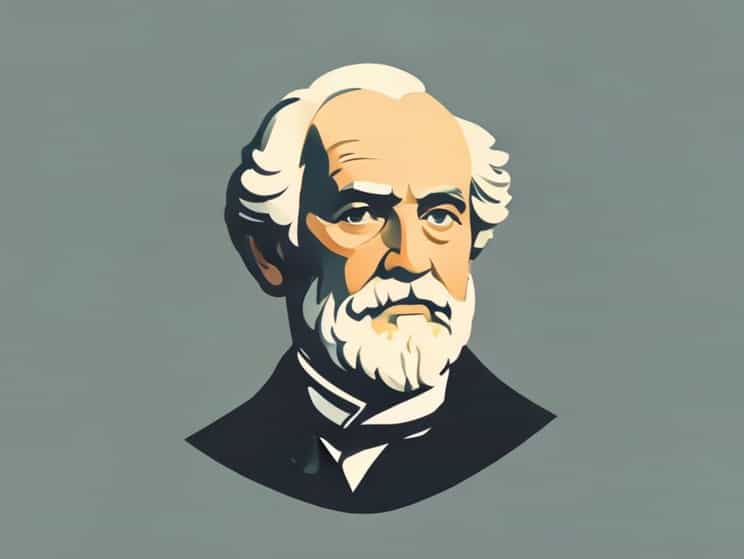
When people discuss the foundations of modern computing, the name George Boole inevitably arises as one of the greatest thinkers who shaped the digital age long before computers even existed. Born in the 19th century, Boole was a mathematician, logician, and philosopher whose groundbreaking work created a bridge between abstract reasoning and practical application. His genius lay in his ability to transform logic into a structured system that later became the backbone of computer science, digital circuits, and artificial intelligence. The genius of George Boole remains evident today, as his ideas still guide technologies that power everyday life.
Early Life of George Boole
George Boole was born in Lincoln, England, in 1815. His family was not wealthy, but they valued education and nurtured his intellectual curiosity. Boole’s father, John Boole, was a shoemaker with a passion for mathematics and science, and he introduced his son to these subjects at an early age. Although George Boole had limited access to formal schooling, his dedication to self-study enabled him to master languages, mathematics, and logic on his own. By the age of 20, he was already teaching in local schools, showing the remarkable intellectual independence that defined his later work.
Boole’s Passion for Mathematics
From his youth, Boole showed an extraordinary talent for abstract thought. He studied the works of great mathematicians like Isaac Newton and Pierre-Simon Laplace. Unlike many of his contemporaries, Boole sought to connect mathematics with philosophy and logic. His belief that mathematics could explain the laws of thought was revolutionary. This vision gave birth to what we now call Boolean algebra, a system that simplified logical reasoning into mathematical expressions.
The Invention of Boolean Algebra
One of the most important contributions of George Boole was his creation of Boolean algebra. In his groundbreaking book The Mathematical Analysis of Logic, published in 1847, he laid out a new way of thinking about logic using symbols and operations. Later, in his more developed work An Investigation of the Laws of Thought (1854), Boole expanded these ideas further.
Boolean algebra introduced concepts such as AND, OR, and NOT-basic operations that are now fundamental to computer science. Through these simple yet powerful rules, Boole showed how logical statements could be expressed and manipulated mathematically. This approach created a universal language of logic, paving the way for computer circuits, databases, and programming languages.
Applications of Boolean Algebra
The genius of George Boole is most evident in how widely his work applies today. His system is used in
- Computer ScienceEvery digital circuit, from microprocessors to smartphones, relies on Boolean logic to process information.
- ProgrammingSoftware development uses Boolean expressions to control decision-making in algorithms.
- DatabasesQuery languages such as SQL use Boolean operators to filter and retrieve data efficiently.
- Artificial IntelligenceLogical reasoning and decision-making in AI systems are deeply rooted in Boolean principles.
George Boole as a Philosopher
Although often remembered as a mathematician, George Boole also made profound contributions to philosophy. He believed that the human mind follows mathematical laws and that reasoning itself could be expressed through equations. This idea challenged traditional philosophy, which relied heavily on abstract argument rather than measurable analysis. Boole’s philosophical approach created a bridge between rational thought and scientific method, influencing future thinkers in both mathematics and cognitive science.
Teaching and Academic Career
George Boole’s academic career was equally impressive. In 1849, he was appointed as the first professor of mathematics at Queen’s College in Cork, Ireland. There, he dedicated himself to teaching and research, inspiring countless students with his innovative thinking. His lectures combined deep theory with practical application, encouraging others to see the value of mathematics in solving real-world problems. Boole was admired not only for his intellect but also for his humility and dedication to education.
The Genius of Simplification
One of the hallmarks of Boole’s genius was his ability to simplify complex ideas. Logic, before his time, was often seen as abstract and philosophical, reserved for debates among scholars. Boole broke down this complexity into clear, mathematical rules that anyone could apply. This simplification transformed logic into a tool for engineering, science, and technology. Without this step, the development of computers and digital communication would have been impossible.
Boole’s Influence on Modern Computing
The real measure of George Boole’s genius is seen in how his ideas underpin modern computing. In the 20th century, engineers like Claude Shannon recognized that Boolean algebra could be directly applied to electrical circuits. Shannon’s work on digital switching circuits in the 1930s explicitly used Boole’s logical rules to design systems that could perform calculations. From that point on, every computer built relied on Boole’s concepts.
Today, every smartphone, laptop, and digital device functions because of the principles Boole introduced more than a century earlier. His work has become so deeply embedded in technology that it is often taken for granted, yet its importance cannot be overstated.
Recognition and Legacy
During his lifetime, George Boole did not receive the full recognition his work deserved. He lived a relatively modest life and died at the young age of 49 in 1864 due to illness. However, his legacy has grown immensely since then. Today, he is celebrated as the father of modern algebraic logic and a pioneer of computer science. Universities, institutions, and research organizations worldwide honor his contributions, and his work continues to inspire generations of scientists and engineers.
Human Side of George Boole
Beyond his intellectual achievements, George Boole was also known as a kind and devoted family man. He married Mary Everest, the niece of George Everest, after whom Mount Everest was named. Together, they raised daughters who themselves became influential in fields such as education and literature. This personal side of Boole adds depth to his story, showing that his genius was coupled with compassion and a strong sense of responsibility.
Why George Boole’s Genius Still Matters
In today’s digital age, the genius of George Boole matters more than ever. With the rapid growth of artificial intelligence, data science, and digital communication, the fundamental principles he developed are constantly being applied and expanded upon. Understanding Boolean logic is still a core part of computer science education, and new innovations continue to trace their roots back to his groundbreaking work.
The genius of George Boole lies not only in his remarkable intellect but also in his ability to transform abstract reasoning into practical systems that revolutionized the world. His creation of Boolean algebra became the foundation of modern computing, while his philosophical vision reshaped how people understood logic and thought. From digital circuits to artificial intelligence, his influence continues to guide the modern world. George Boole’s life reminds us that great ideas can come from humble beginnings and that true genius leaves a legacy that transcends centuries.