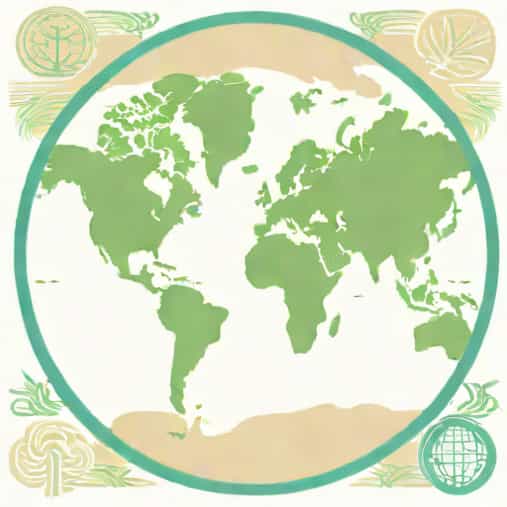
The phrase uttermost parts of the earth appears in the Bible as a powerful expression that captures the breadth of God’s purpose, authority, and mission for humanity. For many readers, this phrase evokes images of distant lands, unknown peoples, and the farthest reaches of the world. It speaks to both geographical distance and spiritual inclusion, emphasizing that God’s message and care are not limited to a single place or group. Understanding the meaning of this biblical phrase helps readers appreciate its theological depth and its relevance for faith, mission, and everyday life.
The Origin of the Phrase in the Bible
The expression uttermost parts of the earth is most commonly associated with the New Testament, particularly in the book of Acts. It reflects a worldview in which the earth is vast, diverse, and filled with people beyond familiar boundaries.
In biblical language, such phrases were often used to describe the farthest imaginable places, not necessarily in a scientific sense, but in a symbolic and practical way that made sense to ancient audiences.
Key Scriptural Context
One of the most well-known appearances of this phrase is found in Acts, where it describes the expanding scope of the Christian mission. The wording emphasizes movement outward, from a central point to increasingly distant regions.
This context highlights that the message being shared was intended for everyone, regardless of location or background.
Literal and Symbolic Meanings
The phrase uttermost parts of the earth carries both literal and symbolic meanings. Literally, it refers to faraway places that lie beyond familiar territories.
Symbolically, it represents inclusion, universality, and the breaking down of boundaries that separate people.
Geographical Understanding
In ancient times, the world was understood in terms of known regions surrounded by unknown lands. The uttermost parts referred to areas at the edge of maps and imagination.
For biblical audiences, this conveyed the idea of extreme distance and the challenge of reaching beyond the familiar.
Spiritual Interpretation
Spiritually, the phrase points to God’s concern for all people. It suggests that no place is too distant and no person too removed to be beyond God’s reach.
This interpretation has been central to how believers understand mission, outreach, and global faith.
The Phrase in the Context of Mission
One of the most important uses of uttermost parts of the earth in the Bible relates to mission and witness. It outlines a vision of faith that is active, outward-looking, and inclusive.
This vision challenges believers to think beyond local concerns and consider a broader responsibility to the world.
From Local to Global Faith
The phrase encourages a movement from familiar spaces to unfamiliar ones. It begins with local communities and extends outward.
This pattern reflects a gradual but intentional expansion of influence and compassion.
Theological Significance
Theologically, uttermost parts of the earth underscores the sovereignty of God. It affirms that divine authority and care extend everywhere.
This understanding reassures believers that God is present and active in all places, even those that seem distant or forgotten.
God’s Universal Authority
The phrase reinforces the idea that no region exists outside of God’s rule. The earth, in its entirety, is included in divine purpose.
This has been a source of comfort and confidence for believers facing uncertainty or opposition.
Historical Influence on Christian Expansion
Throughout history, the phrase uttermost parts of the earth has inspired exploration, mission work, and cultural exchange.
It motivated early believers to travel, translate texts, and build communities across continents.
Understanding the Phrase in Modern Times
In today’s interconnected world, the idea of the uttermost parts of the earth takes on new meaning. With modern communication and travel, physical distance is less of a barrier.
However, cultural, social, and emotional distances still exist, making the phrase just as relevant.
Beyond Physical Distance
Modern interpretations often focus on reaching people who are socially marginalized or spiritually disconnected.
The phrase encourages engagement with those who may feel excluded or overlooked.
Common Themes Associated with the Phrase
- Universality of God’s message
- Inclusion of all peoples
- Mission and outreach
- Breaking cultural and social barriers
Connection to Old Testament Imagery
Although the phrase is prominent in the New Testament, similar ideas appear in the Old Testament. The concept of God’s influence reaching the ends of the earth is a recurring theme.
This continuity shows that the idea of universal reach is deeply rooted in biblical thought.
Encouragement for Personal Faith
On a personal level, the phrase uttermost parts of the earth can be understood as an encouragement to expand one’s faith beyond comfort zones.
It challenges individuals to grow, learn, and engage with perspectives different from their own.
The Phrase as a Call to Action
The biblical use of uttermost parts of the earth is not passive. It implies movement, effort, and commitment.
This call to action has inspired countless acts of service, compassion, and courage.
Living Out the Message
Living out this principle does not always require physical travel. Acts of kindness, understanding, and justice can reflect the same spirit.
Every effort to extend care beyond familiar circles aligns with the deeper meaning of the phrase.
Cultural Impact of the Phrase
The phrase has influenced literature, music, sermons, and everyday language. It has become a shorthand for expressing vast reach and ambitious vision.
Its continued use reflects its enduring power and clarity.
Why the Phrase Still Matters
In a world marked by division and inequality, the idea of reaching the uttermost parts of the earth remains meaningful.
It reminds readers that faith is not meant to be confined but shared broadly and generously.
The Bible verse phrase uttermost parts of the earth carries deep historical, spiritual, and practical significance. It speaks of distance and inclusion, mission and compassion, authority and hope. Far from being an outdated expression, it continues to inspire believers to think globally, act compassionately, and live with a sense of purpose that extends beyond familiar boundaries. By understanding its meaning, readers gain insight into the Bible’s vision of a world fully embraced by divine love and purpose.