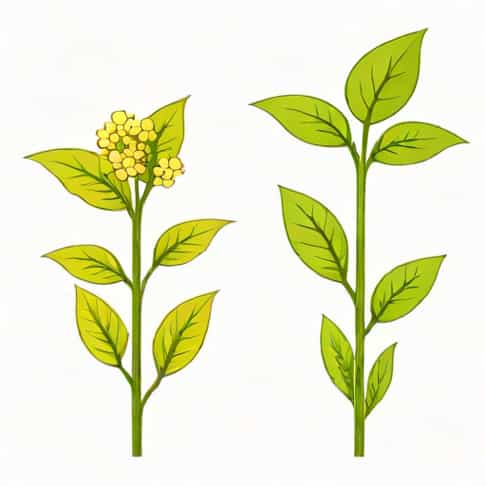
Plants are among the most essential living organisms on Earth, providing food, oxygen, and habitat for countless species. In the study of botany, understanding the differences between plant structures is fundamental. One of the key distinctions in flowering plants is between monocots and dicots, particularly when examining their stems. The stem plays a critical role in supporting the plant, transporting water and nutrients, and storing food. While both monocot and dicot stems serve these purposes, they exhibit significant differences in structure, vascular arrangement, growth patterns, and tissue organization. Exploring these differences helps students, gardeners, and botanists identify plant species and understand their functions.
What is a Monocot Stem?
Monocots, short for monocotyledons, are flowering plants characterized by having a single seed leaf, or cotyledon, in their seeds. The stems of monocots have distinct structural features that differentiate them from dicots. These stems are generally herbaceous, meaning they are soft and flexible rather than woody. Monocot stems support the leaves and flowers while housing vascular tissues that transport water, minerals, and food throughout the plant.
Key Characteristics of Monocot Stems
- Vascular BundlesScattered throughout the stem without a specific arrangement, unlike dicots.
- No Secondary GrowthMonocot stems rarely undergo secondary growth, so they usually remain herbaceous and do not form wood.
- Ground TissueComposed mainly of parenchyma cells, which provide storage and support.
- ExamplesCorn, sugarcane, banana, and bamboo are common monocots.
In monocot stems, vascular bundles contain xylem and phloem, but their scattered arrangement is a defining feature. This pattern affects the stem’s ability to thicken over time and influences its flexibility and strength.
What is a Dicot Stem?
Dicots, or dicotyledons, are flowering plants with two seed leaves, or cotyledons, in their seeds. Dicot stems exhibit a more organized and complex structure than monocots. They can be herbaceous or woody, depending on the species, and often undergo secondary growth, which allows stems to increase in thickness over time. Dicot stems provide support for branches and leaves while facilitating the transport of water, minerals, and nutrients through vascular tissues arranged in a specific pattern.
Key Characteristics of Dicot Stems
- Vascular BundlesArranged in a ring near the perimeter of the stem, unlike the scattered arrangement in monocots.
- Secondary GrowthDicot stems often develop secondary growth due to the presence of cambium, allowing the formation of wood and bark.
- Ground TissueDifferentiated into cortex and pith, providing additional support and storage.
- ExamplesSunflower, hibiscus, rose, and mango are common dicots.
The organized ring of vascular bundles in dicot stems facilitates the formation of new vascular tissues during secondary growth. This contributes to the plant’s ability to grow taller and develop woody stems.
Structural Differences Between Monocot and Dicot Stems
Several structural differences set monocot and dicot stems apart, including the arrangement of vascular bundles, presence of cambium, and growth patterns.
1. Arrangement of Vascular Bundles
- MonocotsVascular bundles are scattered throughout the ground tissue, giving a less organized appearance.
- DicotsVascular bundles form a ring around the stem, creating a more organized and structured layout.
2. Presence of Cambium
- MonocotsLack a vascular cambium, which limits secondary growth and wood formation.
- DicotsPossess a vascular cambium that allows secondary growth, increasing stem thickness over time.
3. Secondary Growth
- MonocotsRarely show secondary growth, so stems usually remain herbaceous and thin.
- DicotsCommonly undergo secondary growth, producing wood and bark in woody species.
4. Ground Tissue Organization
- MonocotsGround tissue is not differentiated into cortex and pith, mostly made of parenchyma cells.
- DicotsGround tissue is clearly differentiated into cortex (outer region) and pith (central region), providing structural support and storage.
Functional Differences
The structural differences between monocot and dicot stems result in functional distinctions that influence growth, flexibility, and adaptation to environments.
Flexibility and Support
- Monocot stems are more flexible and suited for herbaceous growth, allowing them to bend without breaking in windy conditions.
- Dicot stems, especially woody ones, are stronger and provide greater support for taller plants and extensive branches.
Transport Efficiency
- In monocots, scattered vascular bundles allow transport across the stem but may limit the ability to expand with age.
- In dicots, ring-arranged vascular bundles connected by cambium facilitate efficient transport and continuous growth in diameter.
Adaptation and Longevity
- Monocots are often short-lived or seasonal plants, relying on their flexibility and rapid growth.
- Dicots can live longer, develop woody stems, and adapt to diverse environmental conditions due to secondary growth.
Examples of Monocot and Dicot Stems
Recognizing examples of monocot and dicot stems helps illustrate these differences in real-life plants.
Monocot Stem Examples
- Corn (Zea mays) – Scattered vascular bundles and herbaceous stem.
- Bamboo – Woody monocot with scattered bundles, no true secondary growth.
- Banana – Herbaceous stem with scattered vascular bundles, supporting large leaves.
Dicot Stem Examples
- Sunflower – Ring-arranged vascular bundles and herbaceous stem.
- Mango – Woody dicot stem with secondary growth and clearly defined cortex and pith.
- Rose – Woody stem with cambium, allowing thickening over time.
The differences between monocot and dicot stems are significant in both structure and function. Monocot stems are characterized by scattered vascular bundles, absence of cambium, herbaceous nature, and undifferentiated ground tissue. Dicot stems, in contrast, have ring-arranged vascular bundles, possess cambium for secondary growth, can be woody or herbaceous, and exhibit differentiated ground tissue with cortex and pith. These differences influence plant flexibility, strength, longevity, and adaptability. By understanding these distinctions, students, botanists, and gardeners can better identify plant species, appreciate their evolutionary adaptations, and make informed decisions in agriculture, horticulture, and botanical research.