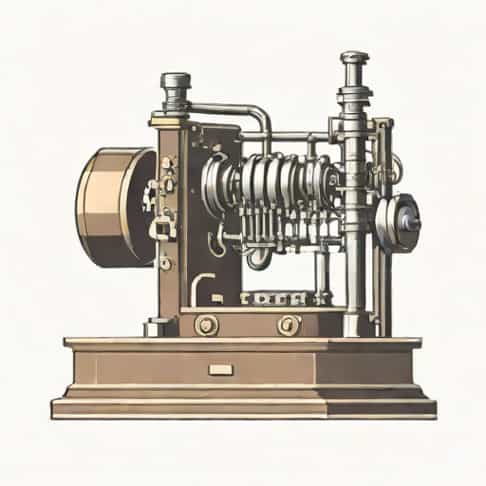
In 1890, Herman Hollerith, an American inventor and statistician, introduced a groundbreaking machine that revolutionized data processing. At a time when the United States Census was growing increasingly complex and time-consuming, Hollerith’s invention provided a faster and more efficient way to tabulate census data. His innovation not only changed the way governments handled information but also laid the foundation for the development of modern computing and data processing technologies. Understanding the context, design, and impact of Hollerith’s machine helps us appreciate the evolution of technology from mechanical devices to the computers we use today.
The Problem of the 1890 United States Census
By the late 19th century, the U.S. population had grown significantly, making the census increasingly difficult to process manually. Previous censuses had relied on clerks to count and tabulate data by hand, a process that took years to complete and was prone to human error. The 1880 census, for example, required nearly a decade to fully process the information. The government sought a more efficient solution to handle the growing volume of data for the 1890 census.
The Need for Innovation
Hollerith recognized the inefficiency in manual data processing and aimed to develop a system that could speed up the tabulation process while maintaining accuracy. The challenge was not just to record information but to sort and count it quickly. This need for automation inspired Hollerith to create a machine that would use punched cards to store and process data.
Herman Hollerith and His Background
Herman Hollerith was born in Buffalo, New York, in 1860. He studied engineering and statistics at Columbia University and was deeply interested in solving practical problems using mathematical methods. His background in statistics and engineering provided the ideal foundation for developing a machine that could handle large amounts of data efficiently. Hollerith’s understanding of both mechanical design and numerical analysis allowed him to create an innovative solution to the census problem.
Inspiration and Early Work
Hollerith was inspired by the work of earlier statisticians who used mechanical tabulating methods, but he sought to improve on their designs significantly. He studied the work of Charles Babbage, who had conceptualized the Analytical Engine in the 19th century, and adapted the idea of automating calculations for practical use. Hollerith combined these ideas with his knowledge of electrical circuits to develop a machine that could read and process information stored on punched cards.
The Invention of the Tabulating Machine
In 1890, Hollerith introduced his tabulating machine, which used punched cards to record information about individuals in the census. Each card represented a person and contained holes punched in specific positions to indicate data such as age, sex, race, and occupation. The machine could read these holes electrically and count the data much faster than human clerks could manually.
How the Machine Worked
The tabulating machine operated by passing the punched cards through a system of pins and electrical contacts. When a pin passed through a hole in the card, it completed an electrical circuit, which triggered a counter. This allowed the machine to tally information automatically. By organizing the data on punched cards, Hollerith’s system could sort, count, and summarize information efficiently, drastically reducing the time required for census tabulation.
Advantages of Hollerith’s Machine
- Increased speed The 1890 census was completed in just two years, compared to nearly ten years for the previous census.
- Improved accuracy Mechanical counting reduced human error in tabulation.
- Scalability The system could handle large volumes of data without significant increases in processing time.
- Data storage and organization Punched cards allowed for easy sorting and retrieval of information.
Impact on the 1890 Census
The introduction of Hollerith’s machine revolutionized the census process. The 1890 U.S. Census was completed on time, and the data was more accurate than ever before. Hollerith’s technology enabled the government to process millions of records quickly, demonstrating the power of mechanized data processing. The success of the machine gained national attention and established Hollerith as a pioneer in the field of information technology.
Economic and Social Effects
Hollerith’s machine not only improved government operations but also influenced broader economic and social developments. Businesses began to see the value of automated data processing for payroll, inventory, and customer information. The success of the machine encouraged further innovation in computing technology, paving the way for future developments in the 20th century.
Hollerith’s Legacy and the Birth of IBM
Hollerith’s company, the Tabulating Machine Company, eventually merged with other firms to form International Business Machines (IBM) in 1911. IBM became one of the most influential technology companies in the world, continuing the work of mechanized and electronic data processing. Hollerith’s invention of the tabulating machine is considered a critical milestone in the history of computing, bridging the gap between mechanical calculators and modern computers.
Influence on Modern Computing
The principles behind Hollerith’s tabulating machine-data storage, sorting, and automated counting-are fundamental concepts in modern computing. The use of punched cards persisted in computing well into the 20th century, influencing the design of early mainframe computers. Hollerith’s work demonstrated that machines could handle repetitive tasks efficiently, a concept that underlies nearly all modern computer applications.
Herman Hollerith’s invention of the tabulating machine in 1890 marked a turning point in data processing. Faced with the challenge of processing an ever-growing census, Hollerith created a system that combined mechanical engineering and electrical technology to automate data collection and counting. His machine not only transformed the way the U.S. government conducted the census but also laid the foundation for the computing revolution. The efficiency, accuracy, and scalability of Hollerith’s invention continue to influence technology today, making him a key figure in the history of computing and data processing.