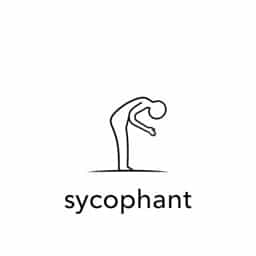
When navigating the richness of the English language, it’s not uncommon to stumble upon unfamiliar or old-sounding words that prompt curiosity. One such word is sycophant. It appears in literature, political commentary, and even casual conversation, often used to describe someone excessively eager to flatter a person in power. But is sycophant actually a word? Where does it come from, and how should it be used correctly? Understanding this word’s origins, meaning, and usage can enhance vocabulary and improve both spoken and written communication.
Is Sycophant a Real Word?
Yes, sycophant is a real and valid English word. It is a noun used to describe someone who acts obsequiously toward someone important in order to gain advantage or favor. In simpler terms, a sycophant is a flatterer or a yes-man someone who praises others insincerely, especially those in authority.
The term is well-established in modern and historical English, recognized by all major dictionaries. It is used both in formal contexts such as essays, debates, and journalism, and informally in day-to-day conversations. While the word may not be as commonly used as more basic terms, it carries a precise and often sharp connotation.
Origin and Etymology of Sycophant
To understand sycophant, it’s helpful to trace its etymology. The word comes from the Greek wordsykophantÄs, which originally had a different meaning possibly referring to someone who informed against fig smugglers in ancient Athens. Over time, it evolved to mean an informer or accuser in general. When the word entered Latin and then English, it took on a new life, shifting to its current meaning related to insincere praise and flattery.
This journey through languages shows how sycophant has been reshaped across centuries, eventually solidifying in English with a strong, negative implication of dishonesty and manipulation for personal gain.
How Is Sycophant Used in Sentences?
The word sycophant functions as a noun, and it’s often used to label someone who appears overly submissive or eager to please, especially toward people in authority. Here are a few examples of how it appears in everyday usage:
- The manager surrounded himself with sycophants who never challenged his decisions.
- History is filled with rulers who were misled by sycophants rather than honest advisors.
- I value constructive criticism, not the flattery of sycophants.
As shown above, sycophant is usually used in a negative or critical context. It suggests not just admiration, but insincerity and self-interest.
Synonyms and Related Terms
Sycophant has several synonyms that are also used to describe people who flatter excessively. Depending on the tone and formality, these terms can be used interchangeably:
- Flatterer
- Brown-noser
- Bootlicker
- Yes-man
- Toady
- Fawner
While all of these terms share similarities with sycophant, they may differ slightly in usage or tone. For example, yes-man is more modern and casual, whereas toady and fawner may be found more in literary or formal contexts. Sycophant tends to be the more scholarly or intellectual choice among them.
Adjective and Verb Forms
The word sycophant is a noun, but there are related forms of speech that derive from it. While the verb form to sycophant is rarely used and not standard, the adjective sycophantic is more commonly seen. Sycophantic describes behavior or language that reflects the traits of a sycophant.
Examples of sycophantic in a sentence:
- His sycophantic remarks made everyone in the room uncomfortable.
- The topic criticized the media’s sycophantic coverage of the celebrity.
There is also the adverb form sycophantically, which refers to actions done in a flattering or fawning way.
Who Is Usually Called a Sycophant?
The label sycophant is most often applied to individuals in workplace or political settings. It describes people who agree with everything a leader says in order to maintain favor or job security. However, it can also be applied in broader social situations, such as in friend groups, school environments, or even online communities.
Here are a few typical scenarios where the term might be used:
- An employee who praises the boss excessively and never offers honest feedback.
- A courtier or official who supports every decision made by a ruler, regardless of logic.
- A fan who excessively flatters a celebrity in hopes of gaining attention.
In all of these cases, the behavior of the sycophant is not genuine and is intended to benefit themselves rather than contribute meaningfully to the conversation or group.
Why Using the Right Word Matters
Understanding and using precise vocabulary like sycophant is important for effective communication. It allows a speaker or writer to convey subtle differences in meaning and intention. Instead of simply saying someone is nice or friendly, describing them as a sycophant offers a very different and more accurate description if their flattery is fake and manipulative.
Additionally, using specific terms like sycophant adds sophistication to writing, especially in persuasive essays, commentary, or political analysis. It helps convey complex ideas in fewer words and with sharper impact.
Modern Relevance and Popular Usage
In today’s world, sycophant has not lost its relevance. In fact, it appears frequently in news media and online discourse. Political analysts often use it to criticize advisors or supporters who are seen as blindly loyal to powerful figures. It is also used in business environments to point out toxic workplace dynamics where truth is suppressed in favor of agreement.
Thanks to social media and digital platforms, the term has even entered meme culture and casual commentary. Although it may not be an everyday word for all English speakers, it remains recognized and understood by those with intermediate to advanced language skills.
Sycophant is without a doubt a real word in the English language. With roots in ancient Greek and a long history of evolution, it now serves as a sharp descriptor for people who engage in insincere flattery to serve their own interests. Whether used in political commentary, workplace critique, or literary writing, sycophant captures a very specific type of behavior that still resonates strongly in modern society.
Learning to recognize and use words like sycophant not only expands your vocabulary but also sharpens your ability to describe human behavior with nuance and accuracy. So yes, sycophant is a word and a powerful one at that.