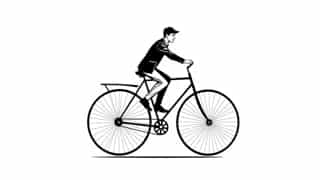
In the late 19th century, a peculiar yet iconic figure began to roll across the cobbled streets and dusty country roads of Europe and North America the man on the penny farthing. This unique sight was more than just an example of early cycling; it was a symbol of progress, adventure, and the daring spirit of a generation that was witnessing rapid technological change. The penny farthing, with its oversized front wheel and diminutive rear wheel, represented the cutting edge of bicycle design before the development of the modern safety bicycle. The men who rode them, often in tailored jackets and flat caps, were viewed as both brave and eccentric, navigating a challenging machine that required not only balance but courage. This topic explores the history, cultural impact, and enduring legacy of the man on the penny farthing.
Origins of the Penny Farthing
The penny farthing, also known as the high wheeler, emerged in the 1870s as an evolution of earlier velocipedes. Its name comes from the British coins the large penny and the much smaller farthing highlighting the size disparity between the two wheels. Invented by British engineer James Starley, the penny farthing was designed for speed. The larger the front wheel, the farther a rider could travel with a single pedal rotation. At the time, it was the most efficient and swift bicycle design available, especially compared to the bone-shaking velocipedes made from wood and iron.
Design and Mechanics
The penny farthing had a front wheel that could be as large as 60 inches in diameter. The pedals were directly attached to the axle of this front wheel, meaning that the rider’s pedaling effort was directly translated into motion. There was no chain drive or gear system. The small rear wheel was included mainly for balance and did little in terms of propulsion. Because the rider sat almost directly over the front wheel, mounting and dismounting required skill, and falling forward was a common hazard, leading to many accidents often called headers.
Who Were the Men on Penny Farthings?
The men who rode penny farthings were often seen as adventurous, athletic, and part of an emerging upper-middle class. These riders were typically young professionals or sportsmen who could afford the cost of the high wheeler, which was not cheap. Unlike today’s commuter cyclists, these men often used their penny farthings more for recreation and racing than for daily travel. They joined cycling clubs, participated in long-distance tours, and competed in early road races. Their choice of vehicle was also a social statement a demonstration of modernity, physical fitness, and sometimes elitism.
Cycling Clubs and Brotherhood
In Britain and parts of the United States, cycling clubs sprang up in cities and towns. These clubs provided a community for enthusiasts, offering organized rides, races, and social gatherings. Uniforms were often worn, and club members took great pride in their cycling skills and the condition of their machines. Riding a penny farthing was more than a hobby; it was a badge of identity, a shared challenge that created bonds among riders. The spectacle of several men on high wheelers riding in formation was a common sight in the late 1800s.
Challenges and Dangers
Despite their popularity, penny farthings were notoriously difficult to ride. Mounting the bicycle required a running start and a quick jump onto the mounting peg located near the rear wheel. The rider then had to swing a leg over and find balance atop the towering front wheel. Dismounting could be equally tricky, especially at speed or on uneven terrain. The biggest risk, however, was the header when the front wheel hit an obstacle, the rider’s center of gravity made it easy to pitch forward, often resulting in serious injury. Helmets were not in use at the time, making every fall a significant danger.
Public Perception
Public reactions to penny farthing riders were mixed. While many admired their daring and grace, others saw them as nuisances or show-offs. Satirical illustrations of the time sometimes mocked penny farthing riders as reckless young men with more bravery than sense. Nonetheless, the image of the man on the penny farthing became a cultural icon, appearing in posters, newspaper cartoons, and even early advertising.
The Decline of the Penny Farthing
By the 1890s, the penny farthing began to fall out of favor due to the invention of the safety bicycle. With two equal-sized wheels, a lower center of gravity, and a chain-driven rear wheel, the safety bicycle was more practical and significantly safer. It allowed more people including women and older individuals to experience cycling. The era of the man on the penny farthing came to a gradual close, replaced by a broader cycling movement that included a wider demographic of riders.
Technological Progress
The decline of the penny farthing was not just about safety; it was also about comfort and utility. The pneumatic tire, better brakes, and improved roads made cycling a more enjoyable and accessible activity. The penny farthing, with all its glory and hazards, became a relic of a transitional period in transportation history a bold but short-lived experiment in human-powered mobility.
Legacy and Modern Revival
Though no longer in mainstream use, the penny farthing has not vanished from public imagination. Enthusiasts around the world still ride, restore, and even race penny farthings. Historical societies, vintage bicycle clubs, and museums celebrate the unique charm of these high wheelers. Events like the Knutsford Great Race in England feature competitive penny farthing races, while vintage parades often include men dressed in period clothing riding these iconic machines.
Symbol of Innovation
Today, the man on the penny farthing is remembered not just for his eccentricity but also for what he represented: a willingness to embrace innovation, take risks, and explore the limits of personal transportation. He stands as a figure from a time when cycling was not just a means of getting from point A to B, but a statement of adventure, endurance, and the human desire to move forward literally and metaphorically.
The penny farthing was a bold invention that captured the spirit of its era. Its riders were part of a technological revolution, pushing the boundaries of what was possible on two wheels. Though their time in the spotlight was brief, these men left an indelible mark on the history of cycling. Today, the image of a man on a penny farthing continues to evoke admiration, nostalgia, and curiosity, reminding us of a time when courage and curiosity rode hand in hand.