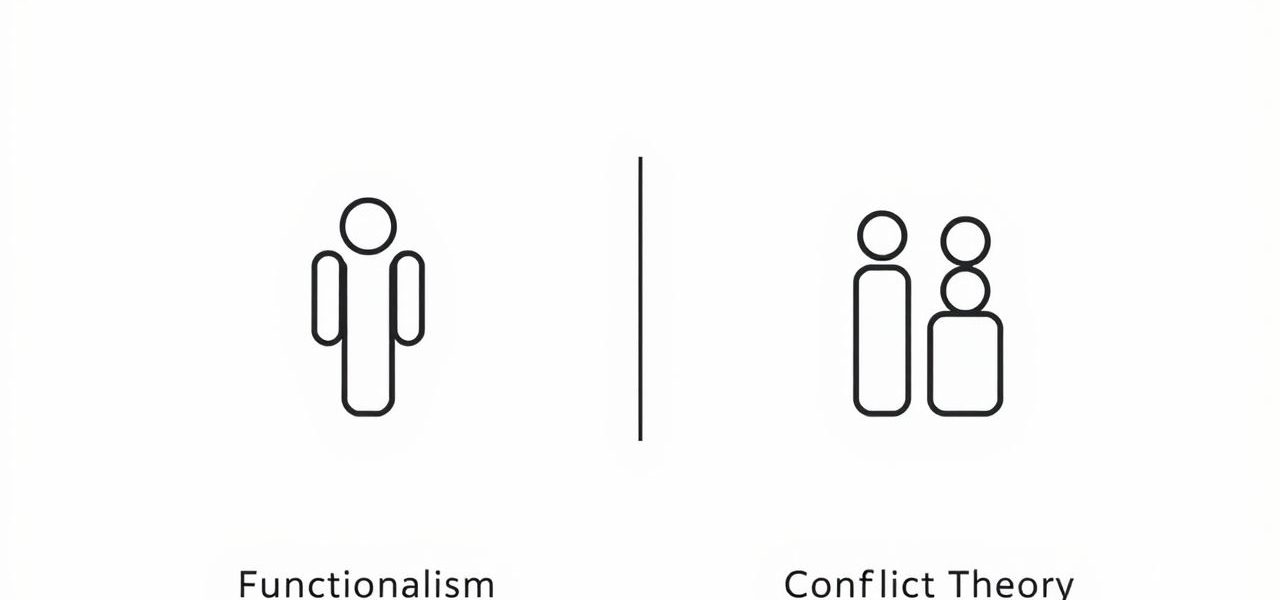
Understanding how societies function and why certain structures persist over time is a central goal of sociology. Among the most influential sociological perspectives are functionalism and conflict theory. These two frameworks provide different explanations for the workings of society, institutions, and human behavior. While functionalism emphasizes harmony and stability, conflict theory focuses on inequality and power struggles. To truly grasp the complexity of society, it is helpful to explore both functionalism and conflict theory, their core principles, differences, and areas of overlap.
Understanding Functionalism
The Core Ideas of Functionalism
Functionalism is a macro-level sociological perspective that views society as a complex system composed of interrelated parts, each serving a specific purpose. Developed in the early 20th century and heavily influenced by thinkers such as Émile Durkheim and Talcott Parsons, functionalism suggests that social institutions and practices exist because they fulfill necessary functions that contribute to the stability and equilibrium of society.
Key Concepts in Functionalism
- Social Structure: The organized pattern of social relationships and institutions that make up society.
- Function: The contribution each part of society makes to social stability and continuity.
- Equilibrium: The balance maintained by the cooperation of social institutions.
- Manifest and Latent Functions: Manifest functions are intended and recognized; latent functions are unintended but still contribute to social stability.
Examples of Functionalism in Society
In a functionalist view, education serves the function of teaching skills, transmitting culture, and promoting social integration. Religion is seen as reinforcing moral behavior and unity. Even crime, though undesirable, is considered functional in defining norms and pushing for social change.
Understanding Conflict Theory
The Core Ideas of Conflict Theory
Conflict theory, in contrast to functionalism, views society as an arena of inequality that generates conflict and change. This perspective, influenced by Karl Marx, focuses on the struggles between dominant and disadvantaged groups over scarce resources such as wealth, power, and status. Conflict theory argues that social structures are not neutral; instead, they serve the interests of those in power while oppressing others.
Key Concepts in Conflict Theory
- Power and Inequality: The distribution of power and resources is unequal and leads to tension and conflict.
- Class Struggle: Ongoing conflicts between different classes, especially between the bourgeoisie (owners) and the proletariat (workers).
- Ideology: Dominant beliefs that justify the status quo and conceal inequalities.
- Social Change: Viewed as both necessary and inevitable due to continued conflict.
Examples of Conflict Theory in Society
Conflict theorists might view the education system as a tool used by the elite to maintain their status, reinforcing class divisions. Laws and law enforcement may serve the powerful more than the general public. Issues such as gender inequality, racism, and labor exploitation are central to conflict theory’s analysis.
Comparison Between Functionalism and Conflict Theory
Points of Agreement
Though their interpretations differ greatly, functionalism and conflict theory do share some common ground:
- Both are macro-level theories that analyze broad social structures.
- Each recognizes that institutions shape behavior and influence individuals.
- They attempt to explain the functions or dysfunctions of societal patterns.
Key Differences
- View of Society: Functionalism sees society as stable and cooperative; conflict theory views it as full of tension and competition.
- Focus: Functionalism focuses on consensus and equilibrium; conflict theory emphasizes power dynamics and inequality.
- Perspective on Change: Functionalism sees change as gradual and necessary for stability; conflict theory sees change as a result of struggles and revolutions.
- Role of Institutions: In functionalism, institutions benefit society as a whole; in conflict theory, they often benefit dominant groups.
The Relevance of Functionalism and Conflict Theory Today
Application in Modern Issues
Both theories remain relevant in analyzing modern social issues. For instance, in the healthcare system, functionalists highlight its role in maintaining public health, while conflict theorists point to disparities in access and treatment. In economics, functionalists focus on the system’s role in distributing resources and jobs, while conflict theorists critique income inequality and exploitation.
Educational Systems
In education, functionalists see schools as preparing students for productive roles in society and reinforcing social norms. Conflict theorists argue that schools perpetuate inequality through hidden curriculums and tracking systems that benefit wealthier, more privileged students.
Social Justice Movements
Conflict theory is often used to explain and support social justice movements. Movements for civil rights, gender equality, and labor rights align with the conflict perspective, as they challenge existing power structures. Functionalism, meanwhile, may offer insights into how such movements eventually integrate into society to create a new, stable order.
Integrating Both Theories for Deeper Understanding
Limitations and Strengths
Each theory has its limitations. Functionalism may downplay social problems and ignore inequalities. Conflict theory, on the other hand, can focus too heavily on strife and may overlook the stability that societies do maintain. By integrating both perspectives, one can gain a more nuanced understanding of social dynamics.
Balanced Sociological Analysis
A combined approach allows researchers and policymakers to recognize both the functions of institutions and the inequalities they may perpetuate. This balance is essential for developing policies that promote both stability and justice.
Both functionalism and conflict theory provide valuable insights into the workings of society. While functionalism highlights how institutions maintain order and support the social system, conflict theory challenges us to see the inequalities and power imbalances that can disrupt harmony. Each theory offers a lens through which we can understand education, law, healthcare, and other critical aspects of life. Recognizing the strengths and weaknesses of both helps us think critically about the world around us, making these frameworks essential tools for anyone interested in sociology, social policy, or public life. Through the exploration of both functionalism and conflict theory, we gain a richer, more comprehensive picture of the forces that shape human societies.