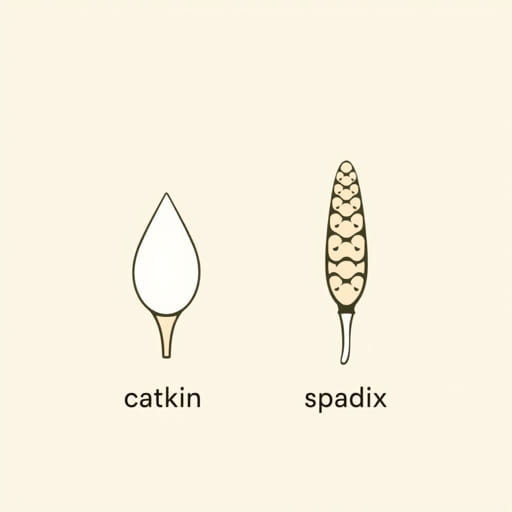
In the field of botany, understanding different types of inflorescences is essential for identifying and classifying flowering plants. Among the various forms of flower arrangements, catkin and spadix are two distinct types that often appear similar at first glance. However, they have different characteristics, structures, and functions that are crucial for botanists, gardeners, and plant enthusiasts to recognize. By exploring the difference between catkin and spadix, we gain a clearer understanding of plant morphology and the specific adaptations plants develop for reproduction.
Understanding Inflorescences
Inflorescence refers to the arrangement of flowers on a plant’s stem. It plays a key role in reproduction, as the structure influences pollination and seed development. There are many types of inflorescences, categorized based on the way flowers are arranged and how they develop. Among them, catkin and spadix are considered special types, mostly found in certain groups of plants such as trees, shrubs, and monocots.
What Is a Catkin?
Definition and Characteristics
A catkin is a slim, cylindrical inflorescence with unisexual flowers, usually without petals. The flowers are tightly packed along a central stem and often hang down from the branches of a plant. Catkins are typically wind-pollinated and are found in many woody plants.
Main Features of Catkins:
- Elongated, drooping structure
- Composed of unisexual, apetalous (no petals) flowers
- Common in trees like willows, poplars, oaks, and birches
- Often appear before leaves during the growing season
- Mostly wind-pollinated
Plants That Produce Catkins
Catkins are seen in both male and female forms. In many species, such as birch and hazel, the male catkins are more noticeable. Female catkins may be smaller and more upright. These structures play an important role in pollination, particularly in trees that rely on wind rather than insects for fertilization.
What Is a Spadix?
Definition and Characteristics
A spadix is a thick, fleshy spike of small flowers arranged along a central stem. It is usually surrounded by a large, often colorful bract called a spathe. Unlike catkins, spadices are typically associated with insect pollination and are common in monocotyledonous plants, especially members of the Araceae family.
Main Features of Spadix:
- Fleshy central axis with numerous tiny flowers
- Surrounded by a modified leaf called a spathe
- Can contain both male and female flowers
- Common in plants like peace lilies, calla lilies, and anthuriums
- Usually insect-pollinated
Plants That Have Spadices
Spadix inflorescences are most famously found in tropical and subtropical plants. The colorful spathe often attracts insects, which serve as pollinators. This structure is both functional and ornamental, making spadix-bearing plants popular in horticulture and interior design.
Comparing Catkin and Spadix
Structure and Appearance
One of the most noticeable differences between catkin and spadix is the structure. Catkins are usually long and hanging, while spadices are upright and thick. Catkins do not have a spathe, whereas spadices are always accompanied by a spathe that may serve to attract pollinators.
Flower Type and Sexuality
- Catkins typically have unisexual flowers, meaning separate male and female structures.
- Spadices often contain both male and female flowers on the same axis, although they can also be unisexual depending on the species.
Pollination Method
- Catkins are usually pollinated by the wind (anemophily), which explains their lack of bright colors or fragrances.
- Spadices are adapted for insect pollination (entomophily), using scent and the surrounding spathe to attract pollinators.
Plant Families and Examples
- Catkins are common in families such as Salicaceae (willow family), Betulaceae (birch family), and Fagaceae (oak family).
- Spadices are characteristic of the Araceae family, which includes philodendrons, taro, and jack-in-the-pulpit.
Ecological Roles and Adaptations
Adaptations of Catkins
The drooping form and light weight of catkins help maximize exposure to the wind. This increases the chances that pollen will be widely dispersed and reach female flowers. These adaptations are suited to temperate zones, where wind is a reliable method of pollination during early spring.
Adaptations of Spadices
The thick, enclosed structure of the spadix offers protection to developing flowers, while the spathe functions like a billboard for pollinators. Some spadices even emit heat or a strong odor to mimic decaying material, which attracts specific insects like flies and beetles.
Why the Difference Matters
Understanding the difference between catkin and spadix inflorescences is more than academic it aids in plant identification, understanding reproductive strategies, and appreciating biodiversity. For botanists, horticulturists, and even casual gardeners, recognizing these two inflorescence types can enhance knowledge of plant life cycles, propagation, and ecology.
Although catkin and spadix may both appear as spike-like flower clusters, their differences in structure, function, and ecology are significant. Catkins are lightweight, drooping, and wind-pollinated, typically found in temperate trees. In contrast, spadices are fleshy, upright, and insect-pollinated, often accompanied by a decorative spathe. By understanding the unique characteristics of each, we gain insight into how plants have adapted to diverse environments and pollination strategies. This knowledge deepens our appreciation of plant diversity and the intricate ways in which nature supports reproduction and survival.