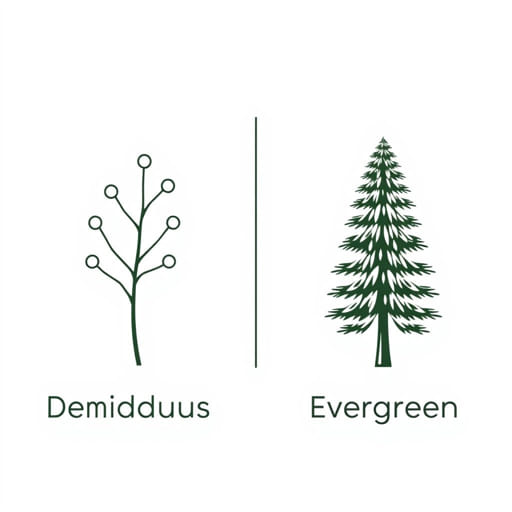
Trees are among the most essential components of Earth’s ecosystems, offering oxygen, shelter, shade, and beauty. When exploring different types of trees, two primary categories often come up: deciduous and evergreen. These classifications describe how trees manage their leaves throughout the year, and understanding the difference between deciduous and evergreen trees can help gardeners, landscapers, students, and nature lovers identify them and understand their ecological roles. While both serve vital purposes in nature, they are structurally and functionally distinct in many ways.
Leaf Retention and Shedding
Deciduous Trees: Seasonal Shedding
Deciduous trees are best known for their dramatic seasonal changes. These trees lose all their leaves during a particular season, usually autumn in temperate climates. The shedding of leaves is a survival strategy to conserve water and energy during colder or drier months. When spring arrives, deciduous trees grow fresh foliage that contributes to photosynthesis during the growing season.
- Leaves turn vibrant shades of red, yellow, or orange before falling
- Common in temperate regions with distinct seasons
- Lose all foliage annually
Evergreen Trees: Year-Round Foliage
In contrast, evergreen trees maintain their leaves all year round. While individual leaves do age and eventually fall, the tree always retains some green foliage. This allows evergreen trees to continue photosynthesis even during the winter months or dry seasons, provided that conditions are not too extreme.
- Foliage remains throughout the year
- Leaves are often waxy, thick, or needle-like
- Found in various climates, including tropical and boreal regions
Leaf Structure and Appearance
Broad Leaves vs. Needles
One of the most visible differences between deciduous and evergreen trees lies in the structure of their leaves. Deciduous trees typically have broad, flat leaves designed for maximum light capture. These leaves are efficient during the growing season but are more vulnerable to cold and drought, prompting their seasonal shedding.
Evergreen trees often have needle-like or scale-like leaves. These adaptations reduce water loss and protect the tree from harsh environmental conditions, such as wind or cold. The leaves are coated with a waxy cuticle to minimize evaporation.
Examples of Tree Species
Typical Deciduous Trees
Deciduous trees are common across various continents and include many familiar species. Their dramatic seasonal changes make them popular in landscaping and forest ecosystems.
- Maple (Acer)
- Oak (Quercus)
- Birch (Betula)
- Elm (Ulmus)
- Beech (Fagus)
Typical Evergreen Trees
Evergreens are widely distributed and vary from towering conifers to tropical rainforest trees. They are valued for their consistent greenery and low-maintenance nature in landscape settings.
- Pine (Pinus)
- Spruce (Picea)
- Cedar (Cedrus)
- Fir (Abies)
- Holly (Ilex)
Climate Adaptations and Distribution
Deciduous Trees in Temperate Zones
Deciduous trees thrive in regions where there are distinct seasonal changes, including cold winters and warm summers. Shedding leaves during the winter reduces water loss when the ground may be frozen and limits damage from snow accumulation. These trees go dormant during the cold months and revive in spring.
Evergreen Trees in Harsh Environments
Evergreens are adapted to a wide range of environments, including nutrient-poor soils and climates with limited rainfall. Conifers, a subgroup of evergreens, are especially well-suited to boreal forests and high altitudes. Tropical evergreens, on the other hand, are found in rainforests where constant leaf production is advantageous.
Growth and Energy Strategy
Seasonal Growth Patterns in Deciduous Trees
Because they shed their leaves, deciduous trees concentrate their growth and energy production into a specific part of the year. Their broad leaves help maximize photosynthesis during the growing season. However, once leaves are dropped, the tree shifts into a period of dormancy, conserving its energy until favorable conditions return.
Year-Round Growth in Evergreen Trees
Evergreen trees grow more slowly than deciduous ones but spread out their energy use over the entire year. This steady growth can be beneficial in climates where extreme seasons are not present. Their foliage allows for consistent, albeit slower, photosynthesis and nutrient absorption.
Ecological Importance
Benefits of Deciduous Trees
Deciduous forests contribute rich organic material to the soil when leaves decompose, enriching the ground with nutrients. These trees provide essential seasonal habitats for animals, including insects, birds, and mammals. The changing canopy also allows more light to reach the forest floor in winter, encouraging biodiversity.
Benefits of Evergreen Trees
Evergreens are crucial in preventing soil erosion, especially on slopes, because their roots hold the soil in place year-round. They also offer consistent cover and habitat for wildlife. In snowy climates, evergreen trees provide protection and food sources for animals during the harsh winter.
Human Uses and Applications
Timber and Landscaping
Both deciduous and evergreen trees are important for timber production. Hardwood from deciduous trees is often used in furniture and flooring due to its density and aesthetic grain. Softwood from evergreens is commonly used in construction, paper production, and utility poles.
In landscaping, deciduous trees are often planted for seasonal visual interest, while evergreens provide year-round greenery, privacy screens, and windbreaks. Combining both types in a garden or landscape creates dynamic visual contrast and ecological balance.
Key Differences at a Glance
- Leaf Retention: Deciduous trees shed leaves annually; evergreen trees keep their leaves all year.
- Leaf Type: Deciduous trees have broad leaves; evergreens have needle-like or scale-like leaves.
- Climate Adaptation: Deciduous trees suit temperate climates; evergreens thrive in a variety of conditions.
- Growth Pattern: Deciduous trees grow seasonally; evergreens grow slowly throughout the year.
- Ecological Role: Deciduous trees enrich soil with fallen leaves; evergreens protect soil and offer consistent habitats.
The difference between deciduous and evergreen trees goes far beyond the presence or absence of leaves. These trees have evolved distinct strategies to survive in their respective environments, whether that means shedding leaves to conserve water or maintaining year-round foliage to continue photosynthesis. Both types of trees play vital roles in nature and human life, contributing to ecosystems, agriculture, forestry, and landscape design. Recognizing the characteristics of each not only deepens our appreciation for the plant kingdom but also guides us in making informed decisions when planting, managing, or studying trees.