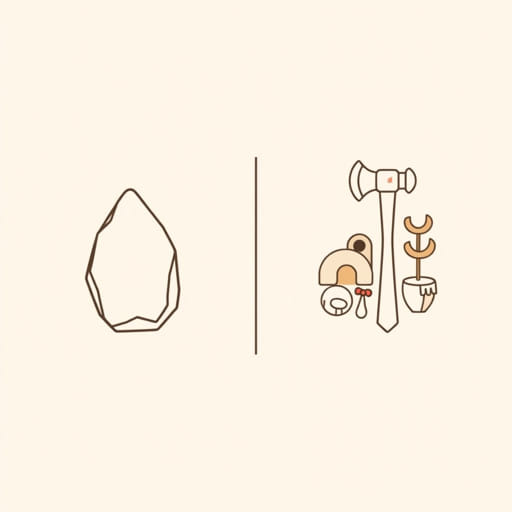
The development of early human civilization can be traced through distinct prehistoric periods, with two of the most significant being the Paleolithic and Neolithic Ages. These two ages represent critical phases in the human journey from nomadic hunter-gatherers to settled agricultural societies. Each era brought about fundamental changes in tools, lifestyle, culture, and societal structure. To understand the differences between the Paleolithic and Neolithic periods, it’s essential to explore various aspects such as technology, economy, society, and human interaction with the environment.
Timeframe and Terminology
Paleolithic Age Overview
The Paleolithic Age, also known as the Old Stone Age, dates from approximately 2.5 million years ago to around 10,000 BCE. This era represents the longest phase of human history. During this time, humans lived in small groups and relied primarily on hunting, fishing, and gathering for survival. The tools used were simple, mostly made from stone, wood, and bone.
Neolithic Age Overview
The Neolithic Age, or New Stone Age, began around 10,000 BCE and lasted until approximately 2,000 BCE, although these dates can vary depending on the region. This period is marked by the advent of agriculture, permanent settlements, and more advanced tools. The Neolithic Revolution transformed human societies, enabling population growth and the formation of complex communities.
Economic and Subsistence Differences
Food Acquisition
- Paleolithic: People depended on hunting wild animals and gathering wild plants. Their food sources were unpredictable and required constant movement to follow animal herds or seasonal plants.
- Neolithic: Agriculture became the main source of food. People began cultivating crops such as wheat, barley, and rice, and domesticating animals like sheep, goats, and cattle.
Impact of Agriculture
The shift from food gathering to food production was a major milestone in human history. Farming allowed Neolithic communities to produce surplus food, which could be stored for future use. This stability led to population growth, the development of trade, and the specialization of labor.
Technological Developments
Tool Making
- Paleolithic: Tools were rudimentary and made primarily from chipped stone. These included hand axes, scrapers, and flint knives.
- Neolithic: Tools became more refined and were polished or ground for sharper and more durable edges. New tools included sickles for harvesting and grinding stones for processing grain.
Innovation and Material Use
In the Neolithic Age, the use of clay for making pottery emerged. Pottery was crucial for storing food and water. Additionally, weaving and textile production began to develop, showing a significant advancement in daily life technology compared to the Paleolithic period.
Societal and Cultural Structure
Settlements
- Paleolithic: People were nomadic and lived in temporary shelters such as caves or simple huts. Their lifestyle required constant movement in search of food.
- Neolithic: Communities began to establish permanent settlements. Villages and even early towns were built, often near rivers or fertile land.
Social Organization
The Paleolithic society was likely egalitarian, with small family groups making decisions collectively. In contrast, Neolithic society began to show signs of hierarchy. With surplus food and labor specialization, roles became more defined, leading to the emergence of leadership and social classes.
Art, Religion, and Communication
Cultural Expressions
Both the Paleolithic and Neolithic Ages produced forms of art, but they differed in style and purpose:
- Paleolithic: Art was often in the form of cave paintings and carvings depicting animals and hunting scenes. These likely held spiritual or ritualistic significance.
- Neolithic: Art evolved to include pottery, figurines, and decorative items. With settled life, architecture became an art form, with structures like stone houses and megaliths such as Stonehenge.
Religious Practices
Paleolithic humans may have practiced animism or shamanism, with a focus on nature spirits and animal worship. In the Neolithic period, religious practices became more organized. Temples and sacred spaces were constructed, and evidence of ritual burials suggests a belief in the afterlife. This shift indicates a more complex understanding of spirituality and community roles.
Language and Communication
While language likely existed during the Paleolithic Age, it was probably limited to basic communication. By the Neolithic period, the need for coordination in farming and communal life may have led to more complex language and early forms of writing or symbolic representation.
Environmental Interaction
Relationship with Nature
- Paleolithic: People lived in harmony with nature, taking only what they needed. Their impact on the environment was minimal.
- Neolithic: Agriculture led to the clearing of forests, irrigation of land, and domestication of animals. While these changes supported human growth, they also introduced environmental challenges such as soil depletion and animal diseases.
Overall Significance and Legacy
Importance of Each Period
The Paleolithic Age laid the foundation of human society. It was during this time that humans developed essential survival skills, used fire, and began forming social bonds. The Neolithic Age, on the other hand, was the beginning of civilization. The transition to agriculture and settled life allowed for the rise of governance, economy, religion, and culture as we know them today.
Transition Between Ages
The shift from the Paleolithic to Neolithic Age didn’t happen overnight. It was a gradual process influenced by climate change, population pressures, and innovation. As glaciers retreated and climates became warmer, regions became more suitable for farming, leading to the Neolithic Revolution in various parts of the world at different times.
The difference between the Paleolithic and Neolithic Ages reflects humanity’s journey from survival-based living to structured society. From the simplicity of hunter-gatherer life to the complexity of agriculture, these periods represent a transformation in human development. Understanding the contrasts in lifestyle, technology, and culture between these two ages provides insight into how far civilization has come and the foundational choices that shaped our present world.