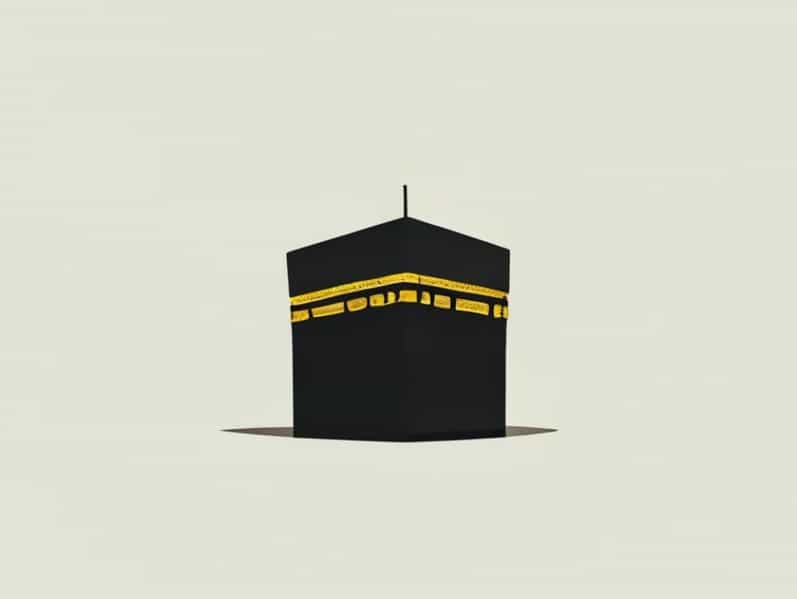
The Kaaba, located in the heart of Mecca, is the most sacred site in Islam, known as the qibla, or direction of prayer, for Muslims worldwide. Its significance in Islam is immense, as it is believed to be the house of God, rebuilt by the Prophet Muhammad along with the community of believers. However, historians, archaeologists, and religious scholars often ask whether the Kaaba predates Islam, and what its origins reveal about the spiritual and cultural history of the Arabian Peninsula. Understanding the history of the Kaaba involves examining ancient Arabian practices, religious traditions, and early Islamic narratives. This exploration reveals a site that was already a focal point of pilgrimage and spiritual activity long before the advent of Islam, making the Kaaba both a historical and religious landmark of profound importance.
The Historical Origins of the Kaaba
The Kaaba’s origins are the subject of both historical inquiry and religious tradition. Islamic tradition holds that the Kaaba was originally built by the Prophet Abraham (Ibrahim) and his son Ishmael (Ismail) as a house dedicated to the worship of one God. This foundational narrative places the Kaaba at the center of monotheistic devotion long before the emergence of Islam in the 7th century CE. According to these accounts, Abraham and Ishmael established the Kaaba as a spiritual center for worship and pilgrimage, intending it to be a site of purity and devotion.
Outside of religious tradition, historians have examined pre-Islamic Arabian culture to understand the Kaaba’s function and significance. Archaeological and historical studies indicate that the Kaaba was a focal point of Meccan society for centuries, serving as a sanctuary and place of gathering. It was already associated with religious practices and housed various idols representing local deities. Tribes across the Arabian Peninsula revered the Kaaba as a sacred site, even if their practices were largely polytheistic rather than monotheistic. This suggests that the Kaaba predates Islam in terms of its physical presence and spiritual significance.
The Kaaba in Pre-Islamic Arabia
Before the advent of Islam, Mecca was a center of trade, culture, and religion. The Kaaba served as a central sanctuary where tribal leaders and pilgrims could converge. Historical records describe the Kaaba as containing numerous idols, each representing different tribal gods and spirits. These idols were worshipped alongside rituals designed to ensure prosperity, protection, and fertility. The structure’s sacred status attracted pilgrims from across the Arabian Peninsula, demonstrating its role as a longstanding religious center.
Polytheistic Practices
Pre-Islamic Arabia was predominantly polytheistic, with the Kaaba functioning as a hub for idol worship. Tribes from different regions would bring their own deities, integrating them into the Kaaba complex. Some of the prominent idols included Hubal, al-Lat, al-Uzza, and Manat, each representing different aspects of life and the natural world. While these practices were later abolished with the rise of Islam, they underscore the Kaaba’s role as a religious and cultural institution long before Muhammad’s prophethood.
Pilgrimage Traditions
Even before Islam, pilgrims visited the Kaaba for religious ceremonies. Annual gatherings, fairs, and festivals were held at the site, blending religious devotion with social and commercial activities. These early pilgrimages established a pattern that Islam later reformed and sanctified under monotheistic worship. The continuity of pilgrimage traditions highlights how the Kaaba served as a spiritual focal point for centuries, bridging pre-Islamic and Islamic religious life.
Islamic Reformation of the Kaaba
With the emergence of Islam in the 7th century CE, the Kaaba was redefined as the central house of monotheistic worship. Prophet Muhammad is credited with cleansing the Kaaba of idols and reestablishing it as a shrine dedicated solely to Allah. This transformation marked a theological and spiritual shift, redirecting the longstanding religious significance of the Kaaba from polytheism to monotheism. The structure itself, however, continued to occupy the same location and maintained its function as a center for communal worship and pilgrimage.
The Qibla and Prayer
One of the most important Islamic reforms associated with the Kaaba was its designation as the qibla, the direction toward which Muslims pray. This universal orientation underscores the Kaaba’s spiritual centrality in Islam and unites believers worldwide in ritual devotion. By establishing a uniform focus for prayer, Islam transformed the Kaaba from a local sanctuary into a global symbol of faith and unity.
Hajj and Spiritual Continuity
The pilgrimage to Mecca, known as Hajj, also builds upon pre-Islamic traditions. While the rituals were modified to align with monotheistic worship, the annual gathering echoes the longstanding practice of journeying to the Kaaba for spiritual fulfillment. This continuity illustrates that the Kaaba’s sacred status predates Islam, even though its meaning and function were transformed by Islamic teachings.
Archaeological and Historical Evidence
Evidence for the Kaaba’s pre-Islamic origins comes from historical accounts, inscriptions, and early Islamic literature. Sources such as Ibn Ishaq’s biography of Muhammad and later historical chronicles describe the Kaaba as an established sanctuary before the rise of Islam. Archaeological research, while limited due to the sacred nature of the site, suggests that the Kaaba has been a focal point of construction, repair, and ritual activity for centuries, supporting the idea that its significance predates Islamic monotheism.
Early References
Historical records indicate that the Kaaba was recognized across Arabia as a sacred site. Poetry, trade documents, and tribal histories from pre-Islamic Arabia refer to Mecca as a center of pilgrimage, commerce, and spiritual activity. These sources reinforce the notion that the Kaaba’s religious importance was well-established before Islam, though the form of worship and the deities venerated were different from those in the Islamic era.
Structural Continuity
The Kaaba’s physical structure has undergone multiple reconstructions, but its location and fundamental role as a religious focal point have remained constant. These reconstructions, both before and after Islam, demonstrate continuity of sacred space, highlighting the Kaaba’s enduring significance in Arabian culture and spirituality.
Theological Implications
The fact that the Kaaba predates Islam carries important theological and cultural implications. For Muslims, it underscores the universality of Abrahamic faith, connecting Islam with earlier monotheistic traditions. The Islamic narrative presents the Kaaba as originally established by Abraham and Ishmael, linking pre-Islamic worship to a divine plan that culminated in Islam. Simultaneously, the Kaaba’s pre-Islamic history demonstrates the capacity for spiritual evolution, where sacred spaces can be reinterpreted and purified according to evolving religious beliefs.
- Pre-Islamic significance as a center for tribal worship and pilgrimage.
- Transformation under Islam to monotheistic worship of Allah.
- Continuity of pilgrimage practices, redefined by Islamic rituals.
- Historical evidence supports longstanding sacred status prior to Muhammad.
- Integration of Abrahamic tradition reinforces theological continuity.
Does the Kaaba predate Islam? The answer is yes, both in terms of its physical presence and its role as a sacred site. Archaeological, historical, and literary evidence indicates that the Kaaba was already a center of worship, pilgrimage, and social gathering long before the emergence of Islam. However, its religious meaning and theological function were transformed by the teachings of Prophet Muhammad, who reoriented the Kaaba toward monotheistic devotion to Allah. While pre-Islamic practices included idol worship and polytheistic rituals, Islam redefined the Kaaba as a universal center of spiritual unity, prayer, and pilgrimage. Understanding the Kaaba’s pre-Islamic origins enriches our appreciation of its historical continuity and highlights the adaptive, transformative nature of sacred spaces in human religious experience. The Kaaba thus stands as a unique testament to spiritual evolution, linking ancient Arabian practices with the enduring legacy of Islam.