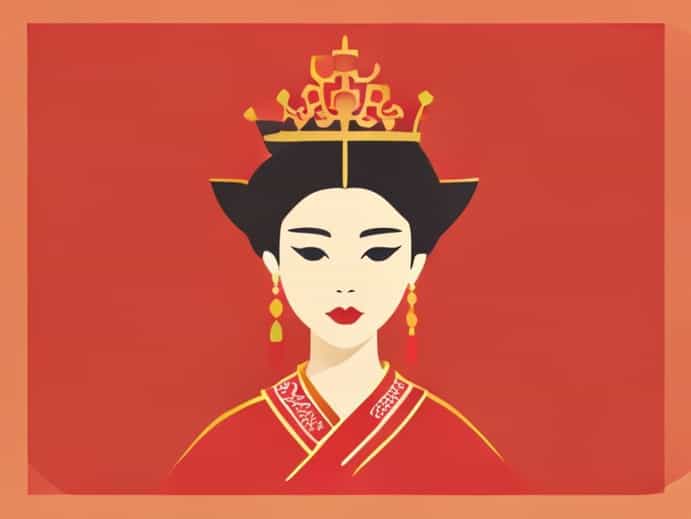
The history of China is rich with emperors and dynasties, but among all the rulers, the empress regnant of China stands out as a rare and fascinating figure. Unlike empresses consort who supported their husbands from behind the throne, an empress regnant ruled in her own right, wielding supreme authority over the empire. The most famous example is Wu Zetian, who became the only female emperor in Chinese history. Her rise to power, political acumen, and efforts to consolidate her rule make her an extraordinary figure in Chinese history, illustrating the complex interplay of gender, politics, and power in imperial China.
The Rise of an Empress Regnant
Becoming an empress regnant in China was extraordinarily rare due to the deeply patriarchal nature of imperial society. Wu Zetian began her journey as a concubine in the court of Emperor Taizong of the Tang dynasty. After his death, she was sent to a Buddhist convent, a common practice for imperial concubines without children. However, Wu later returned to the palace, became a concubine of Emperor Gaozong, and gradually gained political influence. Her intelligence, strategic alliances, and skillful maneuvering allowed her to rise above traditional limitations, eventually assuming the title of empress regnant and ruling the empire in her own right.
Political Acumen and Strategy
Wu Zetian’s rule was marked by exceptional political skill. She implemented reforms that strengthened her position and consolidated power
- Centralization of authority by reducing the influence of aristocratic families
- Promotion of capable officials based on merit rather than birth, a precursor to the civil service examination system
- Use of secret police and intelligence networks to identify and neutralize rivals
- Support for Buddhism as a state religion, which legitimized her rule and increased public support
Her strategies ensured stability in the empire and allowed her to maintain control despite resistance from traditional power structures.
Reforms and Achievements
As an empress regnant, Wu Zetian implemented significant reforms that had lasting effects on Chinese society and governance. One of her major contributions was the expansion of the civil service examination system, which allowed individuals of lower social status to rise to prominent government positions. This move challenged the entrenched aristocracy and encouraged a merit-based bureaucracy, improving administrative efficiency and fostering social mobility.
Economic and Cultural Contributions
Under her rule, China experienced economic growth and cultural flourishing. She encouraged agricultural development, land redistribution, and improvements in infrastructure, including roads and canals, which facilitated trade and communication. Wu also patronized literature, art, and education, promoting cultural achievements that would influence Chinese society for generations. Her reign is often noted for its balance of political pragmatism and cultural enrichment.
Buddhism and Religious Influence
Wu Zetian used religion strategically to reinforce her authority. Buddhism, in particular, was promoted as a state religion, providing a moral and philosophical justification for her unprecedented rule as a female sovereign. She commissioned Buddhist texts, constructed temples, and encouraged the spread of Buddhist teachings. This alignment with religion helped legitimize her authority in a society traditionally dominated by male rulers and Confucian ideals.
Challenges and Controversies
Despite her achievements, the empress regnant faced considerable opposition and controversy. Many contemporaries viewed her ascent as a disruption of the natural order, and Confucian scholars criticized her rule as unnatural. She faced conspiracies, rival factions, and attempts to remove her from power. To maintain control, Wu Zetian was often ruthless, employing strategies that included political purges and the elimination of opponents. While these actions secured her reign, they contributed to a mixed historical legacy, combining admiration for her abilities with criticism for her methods.
Legacy of Wu Zetian
Wu Zetian’s legacy as the empress regnant of China is complex but undeniably significant. She broke gender barriers, demonstrated exceptional leadership, and implemented reforms that shaped the Tang dynasty and later Chinese governance. Her rule challenged traditional norms, showing that a woman could wield supreme power in a patriarchal society. Historians recognize her as a pioneering figure in Chinese history, whose influence extended beyond her lifetime through political, cultural, and religious reforms.
Comparison with Other Female Rulers
While Wu Zetian remains the only officially recognized empress regnant in China, her example invites comparison with other female rulers in history. Like Elizabeth I of England or Catherine the Great of Russia, Wu combined intelligence, political strategy, and charisma to consolidate power. However, her rise was uniquely shaped by the dynastic and patriarchal structures of imperial China, making her achievements particularly remarkable. Her story continues to inspire discussions on gender, leadership, and the possibilities for women in positions of authority.
Influence on Modern Perceptions
The life of Wu Zetian has had a lasting impact on both popular culture and academic study. She is featured in literature, television, and historical analysis as an example of female leadership in a male-dominated world. Her rule challenges stereotypes about women’s capabilities in governance and highlights the potential for leadership based on talent, vision, and strategic thinking rather than gender. Modern scholarship often re-evaluates her reign, acknowledging both the achievements and the controversies that defined her time on the throne.
The empress regnant of China, exemplified by Wu Zetian, represents a rare and extraordinary chapter in the history of the Chinese empire. Her rise to power, strategic governance, and transformative reforms demonstrate that leadership and authority are not constrained by gender. While her methods were sometimes controversial, her legacy is one of intelligence, resilience, and innovation. Wu Zetian’s life and reign provide a compelling study of power, politics, and gender, offering valuable lessons for both historical understanding and contemporary discussions on leadership. As the only woman to officially rule China in her own right, she remains a symbol of what can be achieved with determination, skill, and vision in the face of societal constraints.