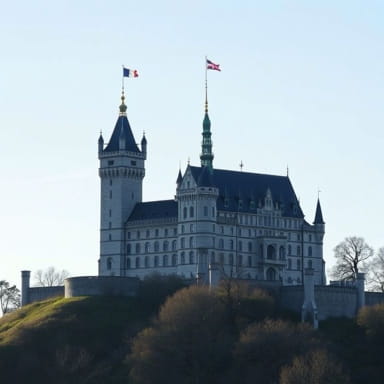
Perched high on Mount Hohenzollern in the Swabian Alps of Germany, Hohenzollern Castle is a striking example of medieval-inspired architecture and historical continuity. Often compared to something out of a fairy tale, this iconic fortress has drawn the admiration of tourists and historians alike. Many wonder when Hohenzollern Castle was built and how its complex history shaped its current form. To understand this architectural marvel is to trace the lineage of the powerful Hohenzollern family and their evolving vision of nobility, strength, and symbolism.
The Origins of Hohenzollern Castle
The First Fortress 11th Century
The original Hohenzollern Castle was constructed in the early 11th century, around the year 1061. This medieval stronghold served as the ancestral seat of the House of Hohenzollern, a dynasty that would later rise to significant prominence in German and European history. Built primarily for military and strategic purposes, the initial castle stood as a bastion of feudal power overlooking the surrounding countryside.
Although not much of this original structure remains today, it played a key role in establishing the Hohenzollern family’s influence. Like many early castles, it was constructed using basic fortification methods suited for defense rather than comfort or luxury. Its location high atop a hill nearly 855 meters above sea level offered natural protection and a commanding view, making it nearly impenetrable to invaders.
Destruction and Rebuilding
Over time, the first version of Hohenzollern Castle fell into disrepair and was eventually destroyed in 1423 after a ten-month siege by the Swabian League. Despite this loss, the strategic importance of the site remained, and the family decided to rebuild.
The Second Castle 15th Century
Reconstruction in 1454
The second iteration of Hohenzollern Castle was constructed beginning in 1454. This version was larger and more fortified than the first, reflecting advances in military architecture of the time. It featured more sophisticated defense mechanisms, stronger walls, and expanded living quarters. The rebuild was a collaborative effort involving various branches of the Hohenzollern family, emphasizing their unified strength and resilience.
Unlike the earlier fortress, this second castle also included elements of residential comfort, transforming it into a proper princely residence. However, it still retained a distinctly medieval character, with narrow halls, steep towers, and high battlements designed to repel attackers.
Unfortunately, this second castle also suffered from neglect over the centuries. By the late 18th century, it had fallen into ruin, and only a chapel remained in active use. Yet once again, the legacy of Hohenzollern Castle would be revived through another major reconstruction.
The Third and Present Castle 19th Century
Construction Begins in 1850
The current Hohenzollern Castle, as seen today, is the third structure to stand on the mountain. Construction began in 1850 under the direction of King Frederick William IV of Prussia, a member of the Hohenzollern dynasty. Inspired by the romanticism of the time and the revival of interest in medieval architecture, the new castle was designed to be both a memorial and a symbol of royal power.
This version was not built as a defensive stronghold, but rather as a tribute to the family’s illustrious past. The architectural style blends Gothic Revival and Romantic influences, characterized by ornate spires, decorative turrets, and richly adorned interiors. The construction lasted several decades, with finishing touches completed well into the latter half of the 19th century.
Architectural Highlights
Some of the most notable features of the 19th-century Hohenzollern Castle include:
- The Eagle Gate: A dramatic entry point marked by powerful symbolism of the Prussian eagle.
- The Count’s Hall: A richly decorated room used for events and ceremonies, showcasing stained glass and carved woodwork.
- St. Michael’s Chapel: A spiritual center that dates back to the second castle and was preserved in the reconstruction.
- The Library and Treasury: Rooms containing valuable artifacts, books, and royal insignia.
The final result was not just a residence or a monument it was a romanticized vision of nobility. King Frederick William IV envisioned the castle as a place that would inspire future generations and connect them to the legacy of the Hohenzollern dynasty.
Significance of Hohenzollern Castle
Dynastic Symbolism
Hohenzollern Castle is more than just an architectural marvel it is a visual embodiment of the power and continuity of one of Europe’s most important dynasties. The Hohenzollerns produced several German emperors and kings of Prussia, leaving a lasting impact on the course of European history. The castle stands as a proud reminder of their influence and ambition.
Cultural and Historical Importance
Today, the castle functions as both a private residence and a museum. It houses numerous historical artifacts, including the crown of Wilhelm II, the last German Emperor. Visitors can explore the richly decorated rooms, take in panoramic views from the castle walls, and gain insight into the historical development of Germany through the lens of one family.
Its continued preservation and popularity highlight its value as a cultural and historical site. It is frequently used in films, literature, and tourism marketing as a symbol of old-world grandeur and architectural beauty.
Timeline Summary: When Was Hohenzollern Castle Built?
- First Castle: Built around 1061, destroyed in 1423
- Second Castle: Built in 1454, fell into disuse by the 18th century
- Third and Current Castle: Construction began in 1850, completed later in the 19th century
This three-stage timeline demonstrates that Hohenzollern Castle was not built in a single moment, but evolved across centuries, adapting to changing political, military, and cultural contexts. Each version of the castle reflected the needs and ambitions of its time, from fortress to residence to memorial.
A Living Monument of History
Hohenzollern Castle, with its rich layers of construction and reconstruction, offers a window into over a thousand years of European history. It was first built in the 11th century, rebuilt in the 15th, and finally transformed into the majestic structure we see today in the 19th century. Each phase of its existence tells a story of resilience, legacy, and evolving identity. Today, Hohenzollern Castle continues to captivate visitors from around the world, not only for its breathtaking views and architecture but for the deep historical significance embedded in its stone walls. It remains a testament to the enduring power of the Hohenzollern family and the cultural richness of Germany’s past.