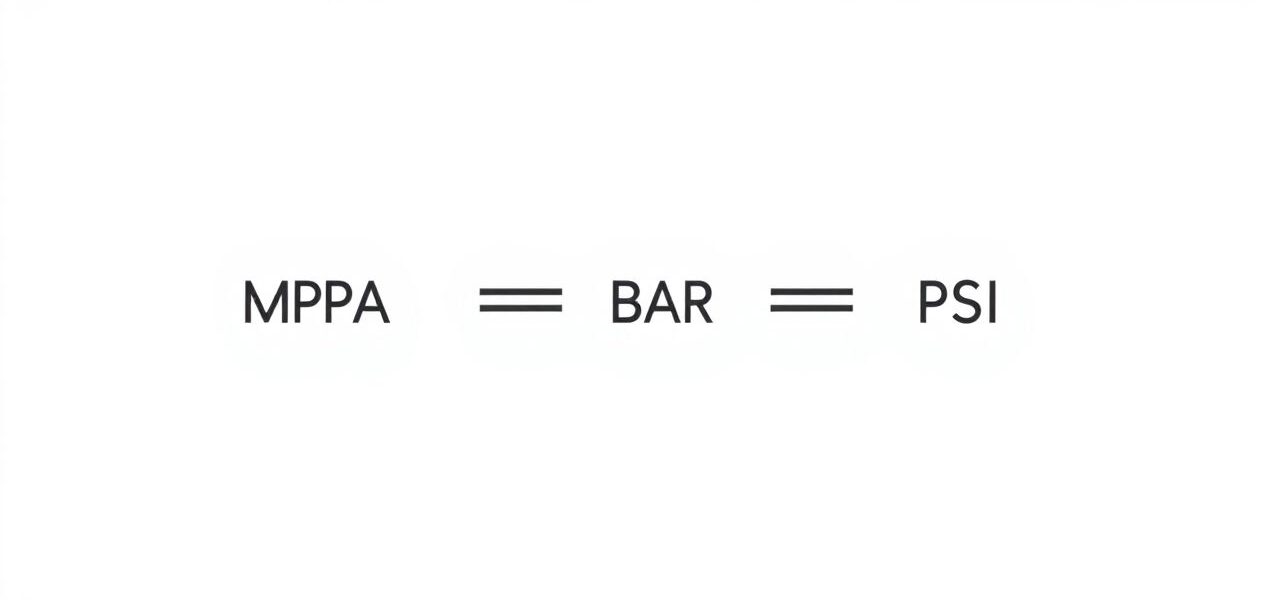
Understanding pressure units like MPa, bar, and PSI is essential in many fields including engineering, manufacturing, automotive systems, and fluid mechanics. These units help us measure the force applied per unit area and are often used interchangeably across various industries and countries. Knowing how to convert between MPa (megapascal), bar, and PSI (pounds per square inch) is important for professionals and students alike. With consistent use and clear knowledge of these units, one can easily read equipment specifications, perform calculations, and ensure compatibility between different systems and standards.
Understanding the Pressure Units
What is MPa (Megapascal)?
MPa stands for megapascal, a metric unit of pressure. It is derived from the Pascal (Pa), which is the SI unit for pressure. One MPa is equal to one million pascals:
1 MPa = 1,000,000 Pa
This unit is widely used in high-pressure applications such as hydraulics, structural engineering, and material testing due to its ability to represent large values in a manageable form.
What is Bar?
Bar is another metric unit of pressure commonly used in Europe and in automotive applications, such as tire pressure measurements. It is not an SI unit but is accepted for use with the SI system. One bar is defined as:
1 bar = 100,000 Pa
This makes it convenient for representing atmospheric pressure, which is close to 1 bar at sea level.
What is PSI?
PSI stands for pounds per square inch and is a unit from the imperial system. It is commonly used in the United States and in industries like aviation and automotive systems. One PSI is defined as:
1 PSI = 6,894.76 Pa
Because it’s based on pounds and inches, PSI is useful for applications involving American engineering standards and systems.
Conversion Formulas Between MPa, Bar, and PSI
MPa to Bar
To convert MPa to bar, use the following formula:
1 MPa = 10 bar
For example, 2.5 MPa equals 25 bar.
MPa to PSI
To convert MPa to PSI, use this formula:
1 MPa = 145.038 PSI
So, 3 MPa equals approximately 435.11 PSI.
Bar to PSI
If you want to convert bar to PSI:
1 bar = 14.5038 PSI
Thus, 5 bar would be about 72.519 PSI.
PSI to MPa
To go from PSI to MPa:
1 PSI = 0.00689476 MPa
Therefore, 150 PSI equals about 1.034 MPa.
Bar to MPa
For converting bar to MPa:
1 bar = 0.1 MPa
10 bar equals exactly 1 MPa.
PSI to Bar
And to convert PSI to bar:
1 PSI = 0.0689476 bar
100 PSI is about 6.895 bar.
Common Use Cases in Different Industries
Automotive Industry
In vehicles, tire pressure is often measured in bar or PSI. Depending on the manufacturer’s country, car manuals and tire gauges may use either unit. For example, 2.2 bar is equivalent to about 32 PSI a common recommended tire pressure.
Hydraulic and Pneumatic Systems
These systems often operate in the range of 5 MPa to 40 MPa, especially in heavy machinery and industrial equipment. The use of MPa simplifies reporting and reading pressure ratings for such high values.
Construction and Civil Engineering
Concrete strength is measured in MPa. For instance, a standard concrete mix might have a compressive strength of 30 MPa. This unit provides precision and is recognized globally in structural engineering standards.
Scientific Research
Scientific labs often use Pascal or MPa in reporting pressure readings in experiments. Researchers prefer SI units for clarity and consistency across international publications.
Conversion Table for Quick Reference
Here is a quick reference chart for common conversions:
| MPa | Bar | PSI |
|---|---|---|
| 0.1 | 1 | 14.5 |
| 0.5 | 5 | 72.5 |
| 1 | 10 | 145 |
| 2 | 20 | 290 |
| 5 | 50 | 725 |
Tips for Converting Pressure Units Accurately
- Always double-check unit labels before performing conversions, especially in technical settings.
- Use a calculator or reliable software when converting between units to avoid manual errors.
- In engineering reports or product specifications, indicate both the original and converted units for clarity.
- Be mindful of rounding; for critical measurements, maintain appropriate decimal precision.
- Understand the context in which the unit is used to determine which conversion is most appropriate.
Why These Conversions Matter
With the global nature of engineering and industrial production, pressure data is often shared internationally. One country may use MPa, another may use PSI, and another may rely on bar. Engineers, technicians, and researchers must be able to understand and convert these units fluently. Whether adjusting machine settings, calibrating instruments, or designing new systems, incorrect conversions can lead to equipment damage or safety issues.
Converting between MPa, bar, and PSI is a practical skill for anyone working in science, engineering, or technical fields. These pressure units are interconnected through simple multiplication factors, and with practice, you can move between them confidently. Remember to always consider the application, maintain accuracy in your calculations, and use appropriate tools or charts for quick reference. Mastery of these conversions enhances both your technical ability and professional versatility in a global context.