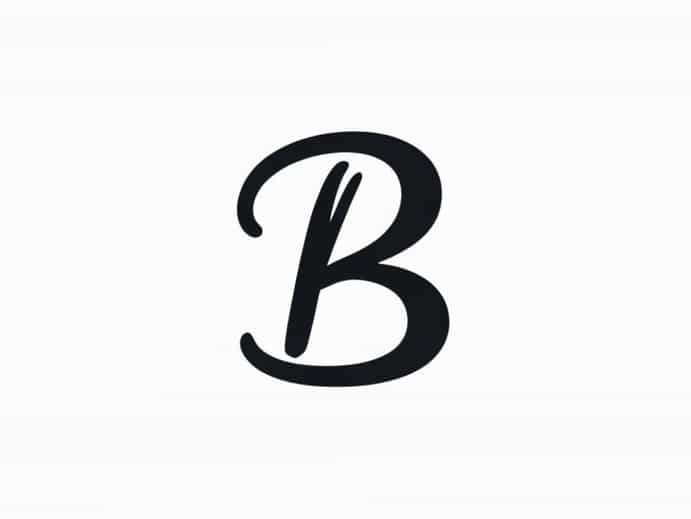
The uppercase B in cursive is an elegant and foundational element of cursive handwriting, representing a blend of artistry and function. Unlike printed letters, cursive letters are designed to flow smoothly into one another, which makes writing faster and visually pleasing. The uppercase B in cursive is often one of the first letters taught to beginners because of its distinctive loops and strokes, which help learners develop proper hand movements and control. Mastering the uppercase B in cursive not only enhances overall handwriting style but also provides a strong foundation for writing other cursive letters with confidence and consistency.
History and Significance of Cursive Writing
Cursive writing has a long history, tracing back to ancient scripts and evolving through centuries into the modern forms we use today. The practice of cursive was initially developed to allow scribes to write more quickly by connecting letters, reducing the need to lift the pen between strokes. Over time, cursive became a standard part of education in many countries, valued for its legibility, speed, and aesthetic appeal. The uppercase B, as part of the cursive alphabet, reflects this heritage by combining functional strokes with a graceful appearance, which is why it continues to be taught in classrooms around the world.
Structure of the Uppercase B in Cursive
The uppercase B in cursive is characterized by its flowing lines and connected loops. Key elements include
- Starting StrokeTypically begins with an upward stroke that curves slightly to the left, providing a smooth entry point for the letter.
- Main Vertical LineThe central vertical line extends downward and forms the backbone of the letter.
- Upper LoopA rounded loop at the top of the letter, often connecting seamlessly to the next letter in a word.
- Lower LoopA larger loop at the bottom, balancing the letter visually and contributing to its overall elegance.
- Connection PointsThe end of the lower loop often extends into a connecting stroke to the following letter, maintaining fluidity in writing.
Learning Techniques for Uppercase B in Cursive
Mastering the uppercase B in cursive requires patience, practice, and attention to detail. Beginners are encouraged to start with basic strokes before attempting the complete letter. Proper posture, pencil grip, and hand positioning play crucial roles in developing fluid movements. Practicing on lined paper helps maintain consistent height, slant, and proportion. Educators often recommend tracing printed examples of the uppercase B in cursive, gradually progressing to freehand writing as learners gain confidence. Regular repetition ensures that muscle memory develops, allowing for smooth and consistent writing.
Step-by-Step Guide
Writing the uppercase B in cursive can be broken down into simple steps
- Begin with an upward stroke from the baseline, slightly curved to the left.
- Draw the main vertical line downward to form the backbone of the letter.
- Create the top loop, ensuring it is rounded and proportional.
- Form the lower loop, making it larger than the top loop to balance the letter visually.
- Finish with a connecting stroke that leads naturally into the next letter.
Common Mistakes and How to Avoid Them
When learning the uppercase B in cursive, beginners often encounter common mistakes that can affect legibility and style. One frequent issue is inconsistent loop size, where the upper loop may be too large or the lower loop too small, disrupting visual balance. Another mistake is improper slant, where the letter leans too far forward or backward. Lifting the pen too often or making disconnected strokes can also break the flow of cursive writing. These issues can be avoided by practicing slowly, focusing on each element of the letter, and gradually increasing writing speed while maintaining proper form.
Tips for Consistency
- Use lined paper to maintain uniform letter height and baseline alignment.
- Practice each loop individually before combining them into a full letter.
- Maintain a slight slant to the right for a traditional cursive appearance.
- Keep strokes smooth and continuous to ensure natural flow between letters.
- Regularly compare handwriting with sample uppercase B letters to assess improvements.
Applications of the Uppercase B in Cursive
The uppercase B in cursive is not only a practice letter but also serves practical and artistic purposes. It is used in personal correspondence, invitations, calligraphy, and artistic designs. In education, it helps students develop fine motor skills, hand-eye coordination, and attention to detail. Learning to write the uppercase B well enables smooth integration into words, sentences, and even creative writing projects. Cursive writing, including the uppercase B, also fosters a sense of elegance and professionalism in handwritten documents.
Advanced Practice and Style Variations
Once the basic uppercase B is mastered, writers can explore stylistic variations to add personality and flair. Some variations include
- Exaggerated loops for decorative purposes
- Italicized slants for a modern cursive appearance
- Thicker lines or shading for artistic calligraphy projects
- Combination with lowercase letters to create smooth and visually appealing words
These variations allow for creativity while retaining the fundamental structure of the uppercase B in cursive.
Benefits of Learning the Uppercase B in Cursive
Mastering the uppercase B in cursive offers multiple benefits beyond improving handwriting. It enhances cognitive development, including fine motor skills, memory retention, and concentration. Writing in cursive encourages faster note-taking and smooth word formation, which can be valuable in academic and professional settings. Additionally, cursive writing, with its flowing and elegant appearance, promotes personal expression and a sense of accomplishment as learners see tangible improvement in their skills.
The uppercase B in cursive is an essential element of handwriting that combines function, beauty, and tradition. Understanding its structure, practicing consistently, and avoiding common mistakes are key to mastering this letter. Beyond its practical uses in writing and communication, the uppercase B contributes to overall handwriting development, motor skills, and aesthetic presentation. By dedicating time to learning and refining the uppercase B, individuals gain confidence in their cursive writing abilities and develop a valuable skill that enhances both daily communication and artistic expression.