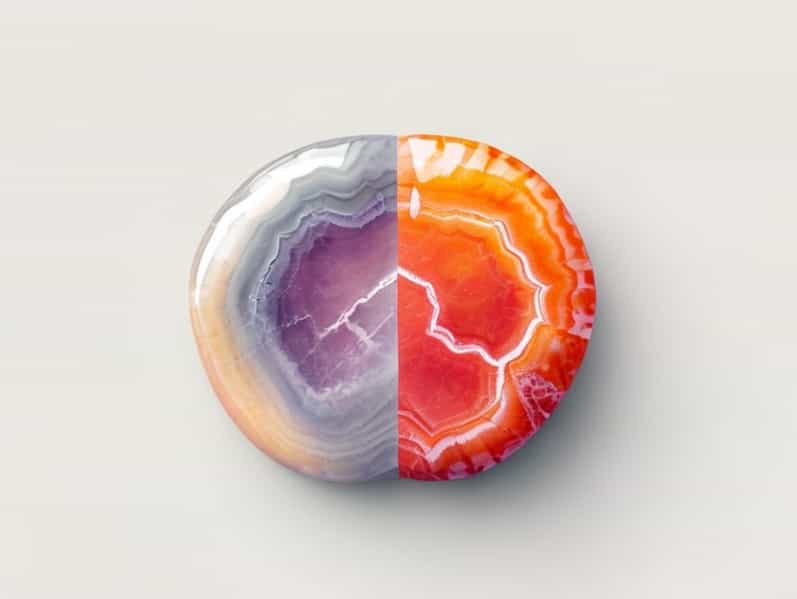
When people explore the world of gemstones, they often encounter stones that look remarkably similar at first glance. Agate and carnelian are two such examples, sharing earthy tones and a connection to the quartz family. However, despite their similarities, these stones carry unique visual qualities, geological differences, and cultural associations that set them apart. Understanding the difference between agate and carnelian helps collectors, jewelry buyers, and crystal enthusiasts make more informed choices. Each stone offers something distinct, whether in appearance, meaning, or everyday use.
Understanding Agate as a Gemstone
Agate is a popular semiprecious stone known for its layered patterns and wide range of colors. It belongs to the chalcedony family, which includes many forms of microcrystalline quartz. The layers that define agate form naturally when silica-rich fluids seep into cavities within rocks, creating beautifully banded structures over thousands of years.
Visual Characteristics of Agate
One of the most recognizable features of agate is its bands. These bands vary in thickness, color, and translucency, forming striking patterns that can appear in concentric circles, flowing waves, or intricate lines. Because of this variety, agate is widely used in decorative objects and jewelry.
-
Banded layers of different colors
-
Translucent to opaque appearance
-
Smooth texture when polished
Color Variations in Agate
Agate comes in nearly every color, including blue, green, pink, grey, brown, and white. Some agates occur naturally in vibrant shades, while others may be enhanced through dyeing processes. This range makes agate one of the most versatile stones for artistic and practical use.
Common Uses of Agate
Because agate is durable and visually interesting, it is often found in home décor, jewelry, carvings, and meditation tools. Its balanced mix of beauty and strength makes it appealing across cultures and design styles.
Understanding Carnelian as a Gemstone
Carnelian, also part of the chalcedony family, is specifically known for its warm reddish-orange hues. This stone has been appreciated for centuries, with historical records showing its use in ancient Egypt, Rome, and Persia for jewelry, seals, and talismans.
Visual Characteristics of Carnelian
Unlike agate, carnelian typically does not have banding. It is valued for its rich, even coloration and slightly translucent glow. While some pieces may show subtle shading differences, the overall appearance remains smoother and more uniform than banded agates.
-
Warm orange, red, or reddish-brown tones
-
Generally uniform in color
-
Translucent to opaque finish
Color Origins in Carnelian
The signature color of carnelian comes from iron oxide within the stone. Natural carnelian can range from pale orange to deep red, and some stones may be heat-treated to enhance their tone. This has been a common practice since ancient times.
Common Uses of Carnelian
Carnelian is frequently used in jewelry such as pendants, rings, and beads. Its bold color makes it a popular gemstone for those who prefer pieces that stand out. Additionally, many people use carnelian for crafts, spiritual practices, or decorative ornaments.
Key Differences Between Agate and Carnelian
Although both stones belong to the same mineral family, their differences are clear once you compare appearance, structure, and formation. These distinctions help identify each stone accurately.
Difference in Appearance
The most noticeable difference between agate and carnelian lies in their visual patterns.
-
Agatedisplays bands or layered patterns that can be bold or subtle, giving each piece a unique artistic look.
-
Carneliantypically has a smooth, uniform color without banding, leaning toward reddish-orange shades.
If a stone has bright stripes, waves, or circular rings, it is almost certainly agate. If it has an even, warm hue, then it is likely carnelian.
Difference in Formation
Agate forms through the layering of silica in rock cavities, which creates its signature bands. Carnelian forms from silica deposits as well, but iron oxide influences its color, and it does not develop the same layered structure. This difference gives each stone its unique texture and pattern.
Difference in Color Range
Agate can appear in nearly any color, often with multiple shades in one stone. Carnelian is more limited, typically appearing in shades of orange, red, or brown. This makes carnelian much easier to identify by color alone.
Difference in Value and Availability
Both stones are generally accessible and affordable, but specific varieties can be more rare.
-
Agate’s value varies depending on pattern detail, natural colors, and overall visual appeal.
-
Carnelian’s value is influenced by color saturation, transparency, and the absence of blemishes.
Difference in Use
Agate’s patterns make it ideal for décor, statement pieces, and large artistic designs. Carnelian, with its uniform color, is more commonly used for simpler jewelry designs where color is the main focus.
How to Tell Agate and Carnelian Apart
For those who are new to gemstone collecting, identifying these stones becomes easier with a few practical tips. Understanding the difference helps avoid confusion and improves confidence when buying or categorizing stones.
Look for Banding
If you see layers, stripes, or rings, the stone is agate. Carnelian rarely, if ever, displays true banding.
Check the Color Tone
Carnelian has warm, fiery hues. Agate may include orange or red shades, but usually accompanied by patterns or different colors in the same stone.
Observe Light Passing Through
Carnelian is often more translucent than many agates. Holding the stone up to light can reveal this difference.
Consider the Stone’s Use
Beaded jewelry with a consistent red-orange tone usually uses carnelian. Decorative slabs or slices with beautiful lines are typically agate.
Cultural and Symbolic Differences
Throughout history, both stones have held symbolic meaning across different cultures, adding depth to their identity.
Agate in History and Myth
Agate has long been associated with stability, grounding, and protection. Ancient cultures believed it could shield its wearer from negative forces. Its layered nature often symbolized balance and harmony.
Carnelian in Tradition
Carnelian has been linked to courage, vitality, and motivation. Warriors and leaders were said to wear carnelian for strength and confidence. Its bold color makes it a symbol of energy and passion.
Understanding the difference between agate and carnelian helps gemstone lovers appreciate the unique qualities each stone brings. Agate stands out for its intricate bands and diverse color palette, while carnelian captivates with its warm, uniform glow. Both come from the chalcedony family, yet they express their beauty in distinct ways. Whether selecting jewelry, building a collection, or simply enjoying the natural artistry of stones, recognizing these differences enriches the experience. By observing pattern, color, and texture, anyone can confidently identify agate versus carnelian and enjoy the special charm each gemstone has to offer.