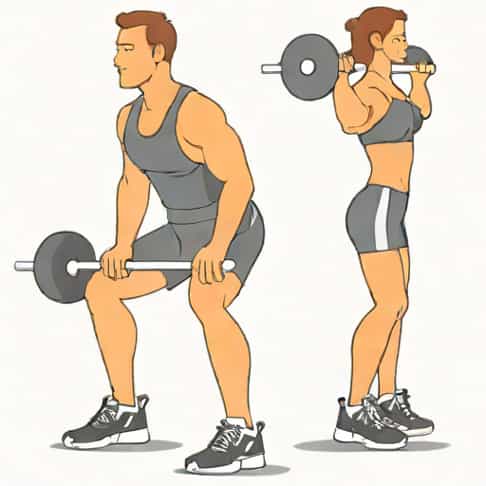
Lower body exercises are essential for building strength, stability, and overall functional fitness. Among the most popular exercises targeting the legs and glutes are the split squat and the lunge. While these movements may appear similar at first glance, they differ in execution, balance requirements, muscle activation, and training benefits. Understanding the difference between the split squat and the lunge is important for anyone seeking to optimize their workout routine, whether for strength training, athletic performance, or rehabilitation. This topic explores these two exercises in detail, highlighting proper technique, variations, benefits, and key differences to help readers make informed choices in their training programs.
Understanding the Split Squat
The split squat is a stationary lower body exercise where one foot is positioned forward and the other foot is positioned backward, maintaining a split stance throughout the movement. Unlike lunges, the split squat is performed without stepping forward or backward, which reduces dynamic movement and allows for more focus on stability and strength in the legs. This exercise primarily targets the quadriceps, glutes, hamstrings, and calves while also engaging the core for balance. Split squats can be performed using bodyweight or additional resistance such as dumbbells, kettlebells, or a barbell.
Proper Technique for Split Squats
- Start in a split stance with one foot forward and one foot back, ensuring both feet are hip-width apart for stability.
- Keep the torso upright and engage the core muscles.
- Lower the body by bending both knees until the back knee nearly touches the floor, ensuring the front knee stays aligned over the ankle.
- Push through the front heel to return to the starting position.
- Repeat for the desired number of repetitions, then switch legs.
Benefits of Split Squats
- Builds unilateral leg strength, targeting quadriceps, hamstrings, and glutes.
- Improves balance and stability without requiring dynamic stepping.
- Reduces stress on the knees compared to lunges due to controlled movement.
- Can be easily modified for strength progression by adding weights.
Variations of Split Squats
- Bulgarian Split SquatPerformed with the back foot elevated on a bench or platform for increased range of motion.
- Dumbbell Split SquatHolding dumbbells in each hand to increase resistance and strength development.
- Barbell Split SquatPlacing a barbell on the shoulders to further challenge lower body muscles.
Understanding the Lunge
The lunge is a dynamic lower body exercise that involves stepping forward, backward, or to the side while performing a squat-like movement. The most common form is the forward lunge, where you step one leg forward and lower the hips until both knees are bent at approximately 90 degrees. Unlike the split squat, the lunge involves movement of the feet, which requires coordination, balance, and core stability. Lunges target the quadriceps, glutes, hamstrings, and calves, while also enhancing functional mobility and athletic performance.
Proper Technique for Lunges
- Stand with feet hip-width apart and engage the core.
- Step one foot forward while keeping the torso upright.
- Lower the body by bending both knees until the back knee is close to the floor and the front thigh is parallel to the ground.
- Ensure the front knee does not extend beyond the toes to prevent strain.
- Push through the front heel to return to the starting position, then alternate legs.
Benefits of Lunges
- Enhances unilateral leg strength and muscle balance between left and right legs.
- Improves coordination, balance, and agility due to the stepping motion.
- Increases functional mobility for daily activities and athletic performance.
- Can be varied to target different muscles and movement planes.
Variations of Lunges
- Reverse LungeStep backward instead of forward, reducing knee stress.
- Lateral LungeStep to the side to target inner and outer thigh muscles.
- Walking LungePerform a series of forward lunges in a walking motion for continuous movement.
- Weighted LungeHold dumbbells or a barbell to increase resistance and strength benefits.
Comparative Differences Between Split Squats and Lunges
Although split squats and lunges share similarities in targeting lower body muscles, their differences in movement, stability requirements, and functional benefits make them unique exercises.
Movement
- Split SquatStationary exercise with no stepping, performed in a fixed position.
- LungeDynamic exercise involving stepping forward, backward, or to the side.
Balance and Stability
- Split SquatFocuses on stability in a fixed stance, easier for beginners or those with balance limitations.
- LungeRequires greater balance, coordination, and core engagement due to movement of the feet.
Range of Motion
- Split SquatOffers controlled range of motion, reducing knee strain and allowing for targeted muscle activation.
- LungeInvolves extended movement, promoting functional mobility and flexibility.
Functional Application
- Split SquatBest for building strength and stability in the legs, particularly for weightlifting and controlled training scenarios.
- LungeEnhances overall functional fitness, agility, and dynamic movement patterns for sports and daily activities.
Muscle Activation
- Split SquatTargets quadriceps and glutes with less emphasis on hip stabilizers due to stationary position.
- LungeEngages quadriceps, glutes, hamstrings, and hip stabilizers more dynamically due to stepping motion.
Choosing Between Split Squats and Lunges
The choice between split squats and lunges depends on individual fitness goals, experience level, and training context. Split squats are ideal for those seeking to build leg strength with controlled, stationary movements, or for beginners developing balance and stability. Lunges are more suitable for athletes or individuals looking to improve functional mobility, coordination, and dynamic strength. Incorporating both exercises into a training program can provide comprehensive lower body development, combining stability, strength, and functional movement patterns.
split squats and lunges are both highly effective lower body exercises, each with unique benefits and applications. Split squats provide controlled, stationary strength training that emphasizes quadriceps, glutes, and hamstrings while improving stability. Lunges offer dynamic movement, promoting functional mobility, balance, and full lower body engagement. Understanding the differences between these exercises helps individuals tailor their workout routines to specific goals, whether for strength, athletic performance, or rehabilitation. By strategically incorporating both split squats and lunges, trainees can achieve balanced, functional, and well-rounded lower body development, enhancing overall fitness, movement efficiency, and performance.
Ultimately, mastering both exercises ensures a versatile and effective lower body workout. Split squats allow for focused strength building and stability enhancement, while lunges contribute to dynamic movement patterns and functional fitness. Recognizing the differences and benefits of each exercise enables individuals to optimize their training programs, prevent injury, and achieve comprehensive lower body strength and conditioning.