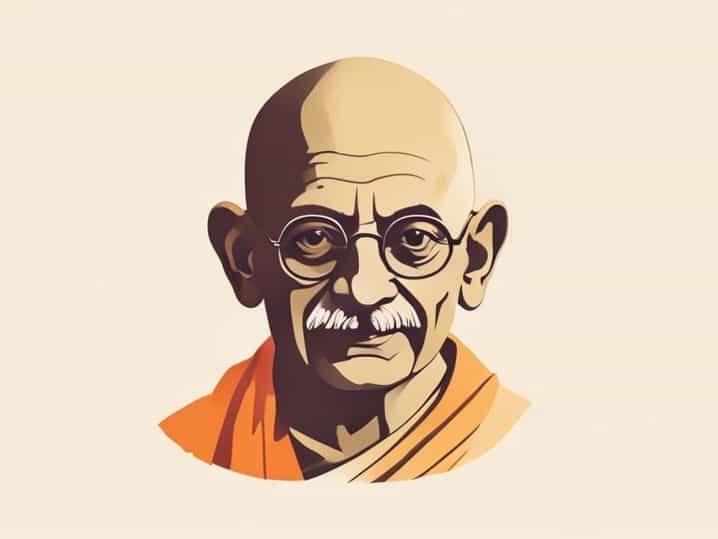
Mahatma Gandhi is one of the most influential figures in modern history, widely recognized for his steadfast commitment to nonviolence and his role in leading India toward independence from British rule. Unlike many revolutionary leaders who advocated armed struggle, Gandhi believed that true and lasting freedom could only be achieved through peaceful means. His philosophy of nonviolent resistance, known as Satyagraha, inspired millions of Indians to take part in protests, boycotts, and civil disobedience campaigns without resorting to violence. Gandhi’s approach not only reshaped the Indian independence movement but also left a global legacy of peaceful activism that continues to influence civil rights and social justice movements around the world.
Gandhi’s Philosophy of Nonviolence
At the core of Gandhi’s strategy was the principle of nonviolence, orahimsa. This principle was more than just a tactical choice; it was a moral and spiritual commitment. Gandhi believed that harming others, even in pursuit of justice, would ultimately undermine the legitimacy of the cause and corrupt the individual. Nonviolence, in his view, required immense courage, discipline, and self-restraint. It was a means of asserting moral authority over oppressors and appealing to the conscience of both the rulers and the general public.
The Concept of Satyagraha
Satyagraha, which translates to truth force or soul force, was Gandhi’s method of nonviolent resistance. It involved peaceful protests, strikes, boycotts, and other forms of civil disobedience aimed at challenging unjust laws and policies. Satyagraha was not passive; it required active participation and personal sacrifice. Gandhi emphasized that suffering endured without retaliation could awaken the conscience of the oppressor and inspire social and political change. This philosophy became the foundation for major campaigns during India’s struggle for independence.
Nonviolent Campaigns for Indian Independence
Gandhi led numerous nonviolent campaigns that demonstrated the power of peaceful resistance. One of the earliest examples was the Champaran Satyagraha in 1917, where he supported farmers who were being exploited by British planters. By organizing peaceful protests and negotiations, Gandhi helped secure fair treatment for the farmers, showing that nonviolence could achieve tangible results.
The Salt March
Perhaps Gandhi’s most famous campaign was the Salt March in 1930, a 240-mile journey to the Arabian Sea to protest the British monopoly on salt production and taxation. Thousands of Indians followed Gandhi in this nonviolent march, defying colonial laws peacefully. The Salt March captured international attention and galvanized Indian society, demonstrating the effectiveness of nonviolent civil disobedience on a national and global stage.
Boycotts and Civil Disobedience
Gandhi also advocated for widespread boycotts of British goods, schools, and legal institutions. By refusing to participate in colonial economic and political systems, Indians could assert their independence without resorting to violence. Civil disobedience campaigns challenged the legitimacy of British authority while maintaining moral high ground. These strategies inspired ordinary citizens to take part in the freedom struggle, fostering unity and resilience across the country.
Impact on Indian Society
Gandhi’s nonviolent approach had a profound impact on Indian society. It encouraged ordinary citizens, including women and marginalized groups, to participate in the independence movement. By framing the struggle as a moral and ethical fight rather than a violent confrontation, Gandhi enabled a broad-based movement that transcended class, religion, and region. His methods cultivated a sense of national identity and collective responsibility, emphasizing that independence required not just political action but also ethical commitment from every citizen.
Mobilizing Mass Participation
One of Gandhi’s key achievements was his ability to mobilize millions of Indians in nonviolent action. Through speeches, writings, and personal example, he inspired individuals to take part in boycotts, marches, and peaceful protests. This mass mobilization put enormous pressure on the British authorities and demonstrated that a disciplined, nonviolent populace could challenge a powerful colonial empire without resorting to armed rebellion.
Global Influence of Gandhi’s Nonviolence
Gandhi’s advocacy for nonviolent resistance extended far beyond India. His philosophy influenced leaders and movements around the world, including Martin Luther King Jr. in the United States, Nelson Mandela in South Africa, and Aung San Suu Kyi in Myanmar. By demonstrating that social and political change could be achieved through peaceful means, Gandhi’s strategies provided a blueprint for civil rights movements and campaigns against oppression globally. His emphasis on moral authority and ethical action continues to resonate with activists seeking justice without violence.
Legacy in Modern Activism
Today, Gandhi’s principles are studied in political science, philosophy, and human rights courses. Nonviolent activism remains a powerful tool for challenging injustice, from environmental campaigns to democratic movements. Gandhi’s insistence on truth, courage, and ethical conduct in political struggle serves as a reminder that power does not always come from weapons or force, but from the collective will and moral determination of people.
Challenges and Criticisms
While Gandhi’s nonviolent approach was largely successful, it was not without challenges and criticisms. Some contemporaries argued that nonviolence was too slow or ineffective against a brutal colonial regime. Others felt that armed struggle was a more immediate and practical path to independence. Gandhi acknowledged these concerns but maintained that violence would only perpetuate cycles of hatred and oppression. His commitment to nonviolence was both principled and strategic, aiming to achieve independence while laying the foundation for a just and ethical society.
Balancing Idealism and Pragmatism
Gandhi’s approach required balancing idealism with practical action. Nonviolent campaigns had to be carefully organized, disciplined, and sustained over long periods. Participants had to endure arrests, violence from authorities, and personal hardship. Gandhi’s leadership emphasized training, planning, and moral education to ensure that nonviolent action remained effective and ethically consistent. This balance between philosophy and practicality was crucial to the success of India’s independence movement.
Mahatma Gandhi’s advocacy of a nonviolent approach to independence transformed the struggle for Indian freedom and left an enduring legacy in global history. By promoting Satyagraha, civil disobedience, and peaceful resistance, he demonstrated that courage, morality, and discipline could challenge injustice more powerfully than violence. Gandhi’s campaigns mobilized millions, inspired social unity, and provided a model for ethical leadership. His influence extends far beyond India, shaping movements for justice, human rights, and civil liberties worldwide. The story of Gandhi’s nonviolent struggle reminds us that true independence and lasting change can be achieved through steadfast commitment to peace, truth, and the power of collective moral action.