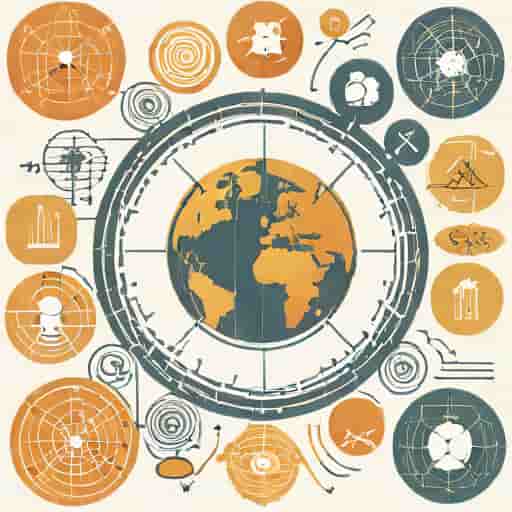
Globalization has become one of the most influential forces shaping the modern world, affecting how people work, communicate, consume culture, and understand who they are. As goods, ideas, technologies, and people move more freely across borders, identities that were once rooted in local traditions now interact with global influences. This interaction is not simple or one-directional. Instead, it creates a dynamic tension between openness and resistance, often described as the dialectics of flow and closure. Understanding this tension helps explain why globalization can produce both cultural mixing and strong reactions that seek to protect or redefine identity.
Understanding Globalization as Flow
At its core, globalization involves movement. This movement, or flow, includes the circulation of capital, information, cultural symbols, labor, and lifestyles across national and cultural boundaries. Advances in transportation and digital communication have accelerated these flows, making the world feel more connected than ever before.
Global flows allow people to access ideas, music, food, fashion, and beliefs from distant places. A teenager in one country can listen to music produced on another continent, while a small business can sell products to customers around the world. These experiences reshape everyday life and influence how individuals see themselves in relation to others.
Identity in a Globalized World
Identity refers to how individuals and groups understand who they are, where they belong, and what values define them. Traditionally, identity was strongly linked to factors such as nationality, religion, language, and local customs. Globalization complicates these links by introducing new reference points.
People today often hold multiple identities at once. Someone may identify with a local community, a nation, and a global culture simultaneously. This layered identity can be empowering, offering flexibility and broader perspectives. However, it can also create confusion or conflict when different identity elements seem to clash.
The Dialectics of Flow and Closure
The concept of dialectics emphasizes the interaction between opposing forces. In the context of globalization and identity, flow represents openness, exchange, and movement, while closure represents boundaries, protection, and stability. These forces do not exist separately; they shape and redefine each other.
As global flows increase, they often provoke responses aimed at closure. These responses may include stricter borders, cultural preservation efforts, or renewed emphasis on national identity. Rather than seeing globalization as a smooth process of integration, the dialectical approach highlights ongoing tension and negotiation.
Cultural Flow and Hybrid Identities
One visible outcome of globalization is cultural hybridity. When cultural elements from different societies interact, they blend and transform. This process can be seen in language, fashion, food, and entertainment. Hybrid identities emerge as people combine global influences with local traditions.
For example, global media introduces new lifestyles and values that coexist with established cultural norms. Individuals may adopt global styles of dress or communication while maintaining traditional beliefs. This blending demonstrates how identity evolves through flow rather than being fixed.
Resistance and the Logic of Closure
While cultural flow can be enriching, it can also feel threatening. Many communities fear that globalization may weaken local traditions, languages, or moral values. In response, they may seek closure by reinforcing boundaries and emphasizing difference.
Closure does not always mean isolation. It can take symbolic forms, such as promoting national heritage, reviving traditional practices, or regulating cultural content. These actions aim to maintain a sense of continuity and control in a rapidly changing world.
Nationalism and Identity Protection
One of the strongest expressions of closure in a globalized world is nationalism. National identity can serve as a source of belonging and security when global forces feel overwhelming. Political movements often draw on national symbols and narratives to reaffirm shared identity.
This does not mean that nationalism is simply a rejection of globalization. In many cases, it coexists with global economic participation while resisting cultural or social change. This selective engagement highlights the complex relationship between flow and closure.
Globalization, Migration, and Identity Negotiation
Migration is another key aspect of globalization that affects identity. When people move across borders, they carry their cultural backgrounds into new environments. Migrants often face the challenge of balancing integration with the preservation of their original identity.
Host societies may respond with openness or resistance. Inclusive policies encourage cultural exchange and hybrid identities, while exclusionary attitudes promote closure. The resulting interactions shape both individual experiences and broader social dynamics.
Media, Technology, and Identity Flow
Digital media plays a central role in accelerating global flows. Social media platforms, streaming services, and online communities allow identities to be expressed and reshaped beyond physical borders. People can connect with others who share interests rather than geographic location.
At the same time, digital spaces can reinforce closure by creating echo chambers. Algorithms often promote content that aligns with existing beliefs, limiting exposure to different perspectives. This shows how flow and closure operate even within global communication networks.
Economic Globalization and Social Boundaries
Economic globalization influences identity by changing how people work and relate to social structures. Global markets create new opportunities but also increase inequality. Those who benefit from global integration may embrace cosmopolitan identities, while those who feel left behind may turn toward local or national identities.
This economic dimension adds another layer to the dialectics of flow and closure. Economic inclusion encourages openness, while exclusion fosters resistance and boundary-making.
The Role of Institutions and Power
Governments, corporations, and international organizations play a significant role in managing globalization. Their policies can promote openness through trade agreements and cultural exchange programs, or enforce closure through regulations and restrictions.
Power dynamics influence whose identities are valued and whose are marginalized. Globalization does not affect all groups equally, and identity struggles often reflect broader inequalities in access and representation.
Everyday Experiences of Globalization and Identity
Beyond large-scale processes, globalization and identity are lived in everyday interactions. Choices about language, clothing, food, and social relationships reflect ongoing negotiation between global influences and local belonging.
Individuals constantly decide when to embrace flow and when to seek closure. These decisions are shaped by personal history, social context, and emotional needs, making identity a fluid and evolving process.
Rethinking Identity in a Connected World
The dialectics of flow and closure suggest that identity in a globalized world is neither completely open nor fully closed. Instead, it is shaped by continuous interaction between movement and stability. Globalization does not erase identity, but transforms how it is constructed and expressed.
By recognizing this tension, it becomes possible to move beyond simplistic views of globalization as either positive or negative. Understanding how flow and closure interact offers a more balanced perspective on identity, one that acknowledges both the possibilities of connection and the importance of belonging.