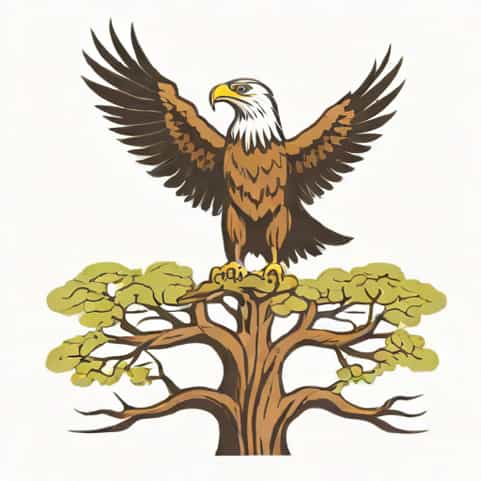
In Norse mythology, Yggdrasil is known as the immense and sacred world tree that connects the nine realms, serving as a cosmic axis around which the universe revolves. At the top of this enormous ash tree, perched in the highest branches, sits a remarkable and mysterious eagle, whose name is not definitively given in the surviving Norse texts. This eagle plays a crucial symbolic role in the mythological tradition, representing wisdom, vigilance, and the connection between heaven and earth. The presence of the eagle atop Yggdrasil is a key element in understanding the structure of Norse cosmology and the interaction between different beings, including gods, giants, and other mystical creatures. This topic explores the identity, symbolism, and mythological significance of the eagle on top of Yggdrasil, providing an in-depth look at its role within the rich tapestry of Norse mythology.
The Myth of Yggdrasil
Yggdrasil is depicted as a massive ash tree whose branches extend into the heavens and whose roots reach into various realms, including Asgard, Midgard, and Niflheim. The tree is central to Norse cosmology, serving as a connection point for gods, humans, and other mythical beings. Its branches and roots are inhabited by a variety of creatures, each with symbolic meaning and narrative importance. Among these creatures, the eagle occupies the highest position, symbolizing a perspective that encompasses the entire cosmos.
Structure of Yggdrasil
- The roots of Yggdrasil reach into the underworld and other realms, providing sustenance and stability to the tree.
- Its trunk spans the middle realms, including Midgard, the world of humans.
- The branches extend into Asgard, the realm of the gods, and other celestial spaces.
- Various creatures inhabit the tree, including the dragon Níðhöggr at the roots, the squirrel Ratatoskr, and the unnamed eagle at the top.
The Eagle on Top of Yggdrasil
The eagle that sits atop Yggdrasil is one of the most enigmatic creatures in Norse mythology. Unlike many other beings whose names and stories are well-documented, the eagle’s specific identity is rarely mentioned in the surviving sources. In some interpretations, the eagle is simply referred to as the eagle, while in others, it is associated with the idea of supreme knowledge and foresight. The eagle is a symbol of vigilance, able to observe the events of all the realms from its lofty perch, serving as a cosmic observer.
Identity and Name
- The eagle at the top of Yggdrasil is often left unnamed in the primary sources, such as the Poetic Edda and the Prose Edda.
- Some interpretations suggest it may be linked to wisdom, similar to other mythological birds, but no specific personal name survives in Norse texts.
- The creature embodies the principle of foresight, seeing events unfold across all nine worlds.
- It is sometimes depicted in illustrations as a large, majestic eagle, emphasizing its symbolic authority over the cosmos.
The Eagle and Vedrfolnir
Between the eyes of the eagle sits a hawk named Vedrfolnir, according to the Prose Edda. This small bird is believed to relay information, communicating with other creatures on Yggdrasil through observation and messages. The relationship between the eagle and Vedrfolnir emphasizes the theme of vigilance and intelligence, as the eagle benefits from the hawk’s perspective while maintaining its dominance over the uppermost branches.
Symbolism of the Eagle
The eagle on Yggdrasil embodies several symbolic meanings within Norse mythology. It represents a perspective that spans all realms, highlighting themes of wisdom, knowledge, and the divine observation of human and cosmic events. The eagle’s position at the very top of the world tree also reflects hierarchy, power, and the interconnectedness of all life.
Wisdom and Knowledge
- The eagle sees everything from its high vantage point, symbolizing omniscience and insight.
- It represents the pursuit of knowledge, as it observes the happenings of gods, humans, and mystical beings alike.
- Its presence suggests that wisdom comes from perspective, vigilance, and the ability to see the bigger picture.
Cosmic Connection
- The eagle serves as a link between the celestial realms and the lower worlds, emphasizing the unity of the universe in Norse cosmology.
- It highlights the tree’s role as a meeting point for all beings, connecting divine and mortal spheres.
- Through the eagle, the myth conveys that all actions in the universe are observed, influencing fate and destiny.
Symbol of Vigilance
- The eagle’s sharp eyes and elevated position emphasize alertness and watchfulness.
- It warns of the constant presence of both protection and potential danger throughout the cosmos.
- Its vigilance is a reminder of the balance between power, observation, and responsibility in Norse mythology.
The Eagle in Cultural and Literary Contexts
Over the centuries, the eagle atop Yggdrasil has inspired writers, artists, and scholars to explore its symbolic significance. While its name remains largely unknown, its role as a cosmic observer has influenced depictions of mythological eagles in literature and modern adaptations of Norse myths. The eagle has appeared in poems, novels, and visual art, often representing wisdom, authority, and the spiritual oversight of the universe.
Modern Interpretations
- Literary adaptations often portray the eagle as a guardian of knowledge, a silent witness to the unfolding of events.
- In visual art, the eagle is depicted perched high in the branches of Yggdrasil, often with Vedrfolnir or other mythological elements nearby.
- Scholars analyze the eagle as a symbol of divine observation and cosmic hierarchy, reflecting its importance in understanding Norse cosmology.
- Popular culture, including video games and novels, sometimes draws on the eagle’s imagery to represent foresight, wisdom, or power.
The eagle on top of Yggdrasil, though largely unnamed in surviving Norse texts, occupies a crucial symbolic role in mythology. Perched atop the world tree, it represents wisdom, vigilance, and the connection between the divine and mortal realms. The presence of Vedrfolnir, the small hawk between its eyes, further emphasizes observation and communication across the cosmic structure. The eagle’s significance extends beyond Norse texts into modern cultural interpretations, where it continues to symbolize insight, authority, and the all-seeing perspective. Understanding the eagle atop Yggdrasil allows readers and enthusiasts of mythology to appreciate the complex interplay of beings, symbolism, and cosmological structure that defines Norse myth and its enduring influence on literature and art.