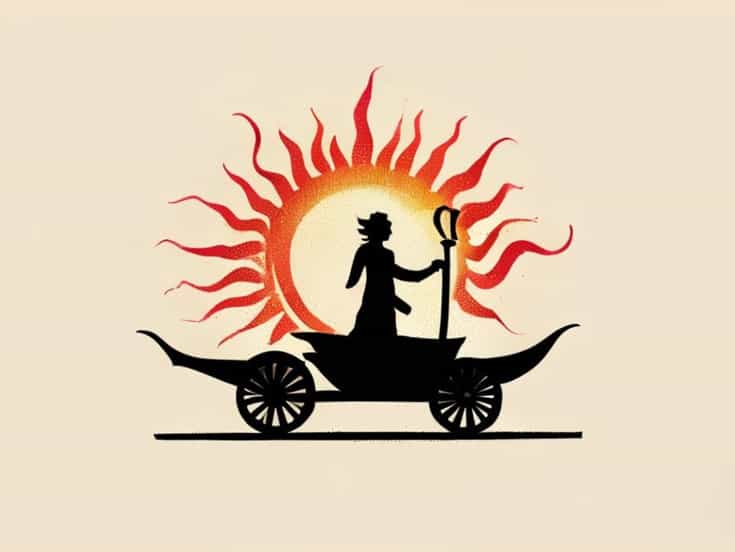
The story of Phaethon and the sun chariot is one of the most dramatic and emotionally charged myths from ancient Greek tradition. It combines themes of ambition, identity, pride, and tragic consequence in a way that has fascinated readers for centuries. At its core, the myth explores what happens when human desire reaches beyond wisdom and preparation. Told and retold by ancient poets, especially in classical literature, the tale of Phaethon offers not only a thrilling narrative but also a moral reflection on limits, responsibility, and the dangers of unchecked confidence.
The Origins of Phaethon
Phaethon was the son of Helios, the god of the sun, and a mortal woman named Clymene. Although Phaethon grew up knowing his divine parentage, he struggled with doubt and ridicule. Other youths mocked him, questioning whether he truly was the son of the sun god. These taunts planted a deep insecurity in his heart.
Determined to prove his identity, Phaethon set out on a journey to meet Helios himself. This desire for validation becomes the driving force of the entire story, showing how personal doubt can push someone toward dangerous decisions.
Meeting Helios, the Sun God
When Phaethon finally reached the palace of Helios, he was overwhelmed by its brilliance. Surrounded by light, gold, and fire, Helios confirmed that Phaethon was indeed his son. Moved by love and pride, the sun god promised to grant Phaethon any wish he desired.
This moment marks a turning point in the story of Phaethon and the sun chariot. Helios’s promise, though sincere, sets the stage for tragedy, as divine power is offered without foresight.
A Dangerous Wish
Phaethon asked for the ultimate proof of his lineage the chance to drive the sun chariot across the sky for a single day. This chariot, pulled by powerful and fiery horses, carried the sun across the heavens and maintained the balance of the world.
Helios immediately realized the danger of this request. He warned Phaethon that even the gods feared controlling the chariot, and that the path through the sky required skill, strength, and experience.
The Sun Chariot and Its Power
The sun chariot was not merely a vehicle; it was a cosmic force. Its daily journey determined the rhythm of day and night, the warmth of the earth, and the balance of nature. The horses were wild and sensitive, responding only to a steady and experienced hand.
Despite Helios’s warnings, Phaethon refused to change his wish. Bound by his oath, Helios reluctantly allowed his son to take the reins. This moment captures a central tension in the myth love versus responsibility.
Phaethon’s Fateful Journey
At dawn, Phaethon climbed into the sun chariot and began his ascent into the sky. Almost immediately, he realized he was in over his head. The horses sensed his weakness and veered off their proper path.
As the chariot flew too high, the earth grew cold. When it plunged too low, the land burned. Forests caught fire, rivers dried up, and deserts were formed. The myth uses vivid imagery to show the catastrophic consequences of losing control over great power.
- The earth scorched by excessive heat
- Rivers and seas evaporating
- Creation of deserts and barren lands
- Disruption of cosmic balance
Zeus Intervenes
Seeing the destruction unfolding, Zeus, king of the gods, was forced to act. To save the world from complete ruin, he struck Phaethon with a thunderbolt. The young driver was thrown from the chariot and fell from the sky into a river below.
This tragic ending underscores the harsh reality of the myth. Phaethon’s death is not portrayed as cruel punishment, but as a necessary act to restore order and protect the world.
Grief and Aftermath
After Phaethon’s death, his mother Clymene searched endlessly for his body, mourning her son’s fate. His sisters, known as the Heliades, wept so long by the river that they were transformed into trees, their tears becoming amber.
These moments add emotional depth to the story of Phaethon and the sun chariot. The myth does not end with destruction alone, but with sorrow, transformation, and remembrance.
Symbolism in the Story
The myth of Phaethon is rich in symbolism. Phaethon represents youthful ambition and the desire for recognition. The sun chariot symbolizes power and responsibility, while the ruined landscape reflects the consequences of acting beyond one’s limits.
Ancient audiences would have understood this story as a warning against hubris, the excessive pride that leads individuals to challenge natural or divine order.
Identity and Validation
At a deeper level, the story explores the human need for identity and acceptance. Phaethon’s tragic choice is rooted in his desire to prove himself to others, making the myth emotionally relatable even today.
The Story in Ancient Literature
The most famous version of the story of Phaethon and the sun chariot appears in Ovid’sMetamorphoses. Ovid’s telling emphasizes emotional conflict, vivid imagery, and transformation, aligning the myth with his broader themes.
Earlier Greek sources also mention Phaethon, though details vary. These differences show how myths evolved over time, shaped by cultural values and artistic expression.
Lessons from the Myth
The story of Phaethon has endured because of the lessons it offers. It warns against reckless ambition, highlights the importance of self-knowledge, and reminds readers that good intentions do not guarantee good outcomes.
It also raises questions about parental responsibility, authority, and the difficulty of saying no, even when love is involved.
Phaethon’s Legacy in Culture
Artists, writers, and thinkers have revisited the myth of Phaethon for centuries. It has inspired paintings, poems, and philosophical discussions. The image of the runaway sun chariot remains a powerful metaphor for loss of control.
In modern interpretations, Phaethon is sometimes viewed with sympathy rather than judgment, seen as a tragic figure rather than a reckless one.
A Timeless Myth of Ambition and Consequence
The story of Phaethon and the sun chariot remains relevant because it speaks to universal human experiences. Ambition, doubt, pride, and the desire for recognition continue to shape lives across generations.
Through its dramatic events and emotional depth, the myth offers a timeless reflection on the balance between aspiration and wisdom. It reminds readers that power requires preparation, and that even noble desires can lead to disaster when pursued without understanding. In this way, the ancient tale of Phaethon continues to shine, not as a story of triumph, but as a cautionary light from the past.