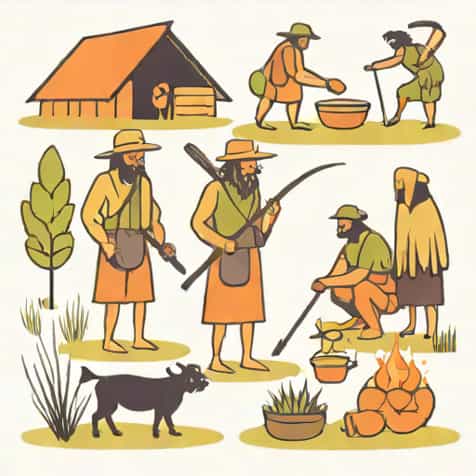
When we think about early human societies, one of the questions that often arises is how people structured their families and relationships. Were hunter gatherers polygamous, or did they prefer monogamy? The answer is not simple, as human mating systems have always been influenced by survival strategies, social bonds, resource availability, and cultural traditions. Exploring this topic allows us to better understand not only the lives of our ancestors but also how these practices may have shaped modern societies and attitudes toward marriage and partnership.
The Social Structure of Hunter Gatherers
Hunter gatherers lived in small, mobile groups where cooperation was essential for survival. Food sharing, group defense, and child-rearing required close collaboration. Because of this, relationships and marriage arrangements were often guided by practical needs rather than strict cultural laws. Some groups leaned toward monogamy, while others allowed forms of polygamy, depending on environmental and social conditions.
Why Relationships Mattered
Partnerships among hunter gatherers were not just about romance. They provided stability for raising children, dividing labor, and forming alliances with other groups. In some societies, polygamous arrangements created broader kinship networks, while in others monogamous unions provided stronger pair bonds between individuals.
Understanding Polygamy in Early Societies
Polygamy refers to having more than one spouse at the same time. Among hunter gatherers, polygamy typically took the form of polygyny, where one man had multiple wives. This was more common in situations where men with higher status, greater hunting skills, or more resources could support larger families. However, it was not universal, and many groups relied primarily on monogamous partnerships.
Factors That Encouraged Polygamy
Several factors influenced whether polygamy was possible or common
- Resource AvailabilityIn regions where food was abundant and men could provide for larger families, polygamy became more viable.
- Status and LeadershipSkilled hunters or leaders sometimes gained social prestige, allowing them to attract more than one partner.
- Population BalanceWhen there were more women than men in a group, polygamy could balance social needs.
- Kinship TiesMultiple marriages could strengthen alliances between families and groups.
Evidence from Anthropological Studies
Anthropologists studying modern hunter gatherer groups, such as the Hadza of Tanzania or the San of Southern Africa, have found that marriage practices vary widely. While monogamy is common, polygamy also appears in certain contexts. These variations suggest that early humans were flexible in their social structures and adapted based on circumstances rather than following a single fixed system.
Polygyny in Practice
When polygyny occurred, it was usually limited to a small number of men. Not every male could have multiple wives, as this would create imbalance and conflict. Instead, high-status individuals sometimes entered into polygamous unions, while the majority remained monogamous. This pattern ensured that most people had the opportunity to form stable families.
The Role of Women in Decision Making
In many hunter gatherer societies, women had more influence than often assumed. They contributed significantly to food gathering, child-rearing, and social cohesion. Because of this, women were not always passive participants in polygamous marriages. In some cases, they chose arrangements that offered security, resources, or social benefits for themselves and their children.
Female Perspectives on Polygamy
For women, being part of a polygamous household could be both beneficial and challenging. Benefits included shared labor, access to resources, and protection. Challenges could include competition between co-wives and unequal treatment. These dynamics varied from group to group and show that polygamy was not simply imposed but negotiated within cultural frameworks.
Monogamy Among Hunter Gatherers
Although polygamy existed, monogamy was often the dominant system among hunter gatherers. This arrangement allowed for stronger pair bonds, which were particularly useful in raising highly dependent human children. Human offspring require long-term care, and monogamous partnerships provided stability for child-rearing and cooperation between parents.
Biological and Social Advantages of Monogamy
Monogamy offered several advantages
- Stronger father-child bonds, ensuring paternal investment.
- Reduced jealousy and conflict within the group.
- More equitable distribution of partners across the community.
- Greater focus on pair cooperation for survival.
Comparisons to Agricultural Societies
When humans transitioned to agricultural societies, marriage systems shifted as well. Farming communities often accumulated more wealth and property, which made polygamy more common among elites. In contrast, hunter gatherers had fewer material possessions, making large polygamous households less practical. This comparison shows how lifestyle and economy strongly shaped marital structures.
From Mobility to Settlement
Mobile hunter gatherers needed flexible family systems, while settled agriculturalists could support larger and more hierarchical family arrangements. This shift in lifestyle is one reason polygamy became more formalized in later societies, while hunter gatherers maintained more varied and adaptive approaches.
Modern Interpretations and Lessons
When asking were hunter gatherers polygamous, it is important to remember that there was no single answer. Some groups practiced polygyny, others were largely monogamous, and many adapted between the two based on their environment. What stands out is the flexibility of human social systems. Rather than being bound to one model, early humans experimented with different arrangements that suited their survival needs.
Implications for Human Nature
This diversity in marriage practices suggests that humans are not naturally locked into one system, whether polygamy or monogamy. Instead, we are adaptable, with cultural and environmental factors shaping our choices. This helps explain why marriage systems around the world today remain so varied, reflecting both ancient traditions and modern innovations.
The question of whether hunter gatherers were polygamous reveals the complexity of early human societies. Evidence shows that while polygamy did occur, it was often limited and situational, with monogamy being equally, if not more, common. The balance between polygamy and monogamy depended on resources, status, and social needs. Ultimately, what we learn from hunter gatherers is that human relationships have always been flexible, adaptive, and deeply connected to the survival strategies of each community. This adaptability continues to influence how societies approach family and marriage in the present day.