Many people encounter polyhedral dice for the first time and wonder why they come in so many shapes, numbers, and configurations. These unusual dice have a long history and serve important functions in gaming, education, probability work, and even creative hobbies. Understanding what polyhedral dice are used for can help new players feel more confident and give hobbyists a deeper appreciation for how each shape contributes to different experiences. Whether someone is exploring tabletop role-playing games or simply curious about probability tools, polyhedral dice offer a fascinating combination of function and imagination.
Understanding What Polyhedral Dice Are
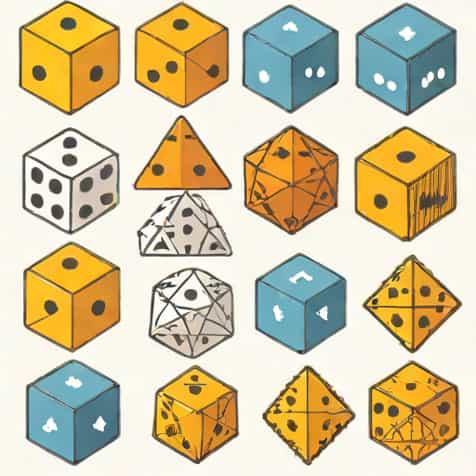
Polyhedral dice are dice shaped like regular geometric solids. Instead of the standard six-sided cube, they come in a wide range of shapes, each with a different number of faces. The most common set includes the d4, d6, d8, d10, d12, and d20. These shapes allow players to generate random numbers across multiple ranges, which is useful in games, storytelling systems, and probability tasks.
Common Shapes in a Standard Dice Set
- d4 – a four-sided tetrahedron
- d6 – the classic cube most people recognize
- d8 – an eight-sided octahedron
- d10 – a ten-sided die often used for percentages
- d12 – a twelve-sided dodecahedron
- d20 – the twenty-sided die famous in role-playing games
Each shape rolls differently and produces numbers differently, which is why they are used for various tasks. The variety makes polyhedral dice far more versatile than standard dice alone.
Primary Use Tabletop Role-Playing Games
The most well-known use of polyhedral dice is in tabletop role-playing games (RPGs). These games rely heavily on chance, character abilities, and unpredictable outcomes. Polyhedral dice allow game systems to simulate everything from minor actions to life-changing events within a fantasy or science-fiction story. Because each die has a different range, players can roll exactly the numbers they need for each situation, creating a flexible and detailed experience.
How Dice Support Game Mechanics
In most RPGs, actions are resolved by rolling a specific die. The d20 is often used for combat, skill checks, and decisions that require wide probability. The d6 may track damage for certain weapons, while the d8 or d12 might represent more powerful attacks. A percentage roll, using two d10 dice, can determine extremely precise outcomes. This variety helps game designers build complex rule systems without overwhelming players.
Enhancing Storytelling and Creativity
Beyond mechanics, the unpredictability of polyhedral dice adds excitement and storytelling value. A high roll might save a character from danger, while a low roll could introduce unexpected obstacles. Many players enjoy collecting dice that match their character’s personality, making polyhedral sets part of the creative expression of the game.
Polyhedral Dice in Board Games
Although RPGs use these dice the most, many board games also rely on polyhedral dice for varied gameplay. Some strategy games use a d8 or d12 to determine movement or attacks. Others include dice as part of resource gathering or probability challenges. The presence of polyhedral dice can make a board game more engaging because it introduces multiple layers of chance and strategy.
Why Designers Use Polyhedral Dice
Game designers choose these dice because they allow for cleaner mathematical distribution. For example, a six-sided die only provides a limited range of probabilities. A d20 allows more nuanced outcomes, making it ideal for balanced scoring, skill development, or strategic risk. As a result, polyhedral dice help create games that feel fair yet exciting.
Educational Uses for Polyhedral Dice
Another important use is in education, especially in math and probability lessons. Teachers often use polyhedral dice to introduce students to concepts like probability distribution, randomness, and statistical analysis. Because each die type covers different numeric ranges, they give students hands-on practice with fractions, chances, and outcomes.
Common Classroom Applications
- Teaching basic probability
- Understanding geometric shapes
- Learning statistics with real data
- Demonstrating randomness and sampling
Students tend to enjoy these activities because polyhedral dice feel more interactive and interesting than simple worksheets. The mix of shapes and colors also helps explain mathematical ideas in a more visual way.
Polyhedral Dice in Probability and Statistics
Researchers, hobby mathematicians, and probability enthusiasts use polyhedral dice to simulate random events. Because dice can be rolled repeatedly, they offer a simple way to model outcomes, test theories, or demonstrate probability patterns without computers. For example, someone studying probability might roll a d8 thousands of times to evaluate how evenly the numbers appear.
Simulations and Experiments
Polyhedral dice help simulate everything from weather patterns to game theories. They are also used in probability tournaments or experiments that challenge participants to predict outcomes. Their simplicity makes them powerful tools for hands-on demonstrations.
Collecting Polyhedral Dice
Many people collect polyhedral dice simply because they enjoy the designs. Dice come in countless colors, materials, and finishes. Some are made of metal, others from gemstone or resin. Unique patterns, engraved numbers, and handcrafted sets make dice collecting a major hobby within the gaming community.
Popular Reasons for Collecting
- Appreciation of craftsmanship
- Desire for matching character sets
- Interest in rare or limited-edition designs
- Enjoyment of color themes and aesthetics
For many players, polyhedral dice are more than tools-they are personal expressions of style. A beautifully crafted d20 can feel like a piece of art as much as a gaming accessory.
Polyhedral Dice in Creative Writing and Story Games
Beyond traditional games, some writers use polyhedral dice to spark creative ideas. Rolling different numbers may prompt plot twists, character traits, or challenges. In collaborative story games, dice help guide the narrative by adding elements of chance. This method keeps creativity fresh and encourages improvisation.
Using Dice for Idea Generation
Writers may assign outcomes to numbers, roll the dice, and build stories based on the results. This technique is useful for overcoming writer’s block or finding unexpected directions. Polyhedral dice provide variety, which leads to richer storytelling possibilities.
Why Polyhedral Dice Remain Popular
Polyhedral dice remain popular because they combine practicality with imagination. They offer precise probabilities, enhance games, support learning, and inspire creativity. Their versatility explains why they appear in classrooms, gaming tables, research labs, and collections around the world.
From role-playing adventures to mathematical experiments, polyhedral dice have become essential tools for countless activities. Understanding what polyhedral dice are used for helps anyone appreciate why they continue to capture people’s interest. Their mix of beauty, function, and versatility ensures they remain a meaningful part of many modern hobbies and educational settings.