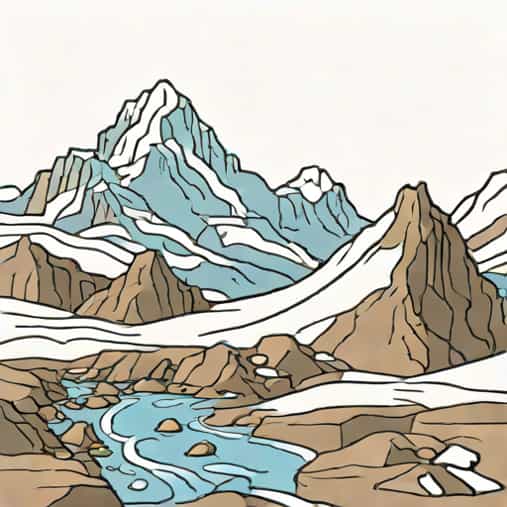
Wind and glaciers both shape the Earth’s surface in powerful ways, even though they operate in very different environments. Over long periods of time, each acts as a natural tool that scrapes, polishes, and removes material from exposed rock. Learning to compare how wind and glaciers abrade rock helps explain desert landscapes, mountain valleys, and the slow transformation of continents. Abrasion by wind and abrasion by glaciers involve motion, sediment, and friction, but the scale, speed, and results are not identical. Understanding these differences gives clearer insight into weathering, erosion, and the processes that build and wear down landforms.
What Abrasion Means in Geology
Abrasion in geology is the process in which moving ptopics grind against rock surfaces, wearing them away over time. It is similar to sandpaper rubbing on wood. The material doing the rubbing can be sand grains, pebbles, or large fragments frozen into ice. Abrasion changes the texture of rock, rounds sharp edges, and sometimes carves grooves or polished faces. Both wind and glaciers cause abrasion, but they do so in distinct ways linked to their environment and energy.
How Wind Abrades Rock
Wind abrasion usually occurs in dry, open landscapes such as deserts, coastal dunes, and bare plains where vegetation is limited. Strong winds lift loose sand and small ptopics into the air or push them along the ground. As these grains strike exposed rock surfaces, they chip away tiny fragments. Over thousands of years, this repeated impact gradually reshapes the surface.
The Role of Sand in Wind Abrasion
Wind alone cannot cut rock, but sediment moved by wind can. Sand grains act as natural tools that scrape, pit, and polish. The ptopics are often carried at low heights, so abrasion is most intense near the ground. This explains why many desert rocks are smooth at the base while the upper portions remain rough.
- Sandblasting effect caused by airborne ptopics
- Most erosion occurs close to the surface
- Requires dry conditions and loose sediment
- Leaves rocks pitted, frosted, or faceted
This process is sometimes called sandblasting because it resembles industrial techniques that clean or smooth metal using high-speed sand flow. Features such as ventifacts, which are rocks with polished flat faces, form as wind-driven sand abrades them from one or more directions.
Speed and Scale of Wind Abrasion
Wind abrasion is generally slow compared to glacial abrasion. Individual impacts remove extremely small fragments of material. However, over geologic time the cumulative effect becomes visible. Wind abrasion also tends to work on exposed, isolated rocks rather than deeply carving into bedrock layers, because the force produced by normal wind speeds is relatively low.
How Glaciers Abrade Rock
Glaciers are massive bodies of moving ice that flow slowly downhill under their own weight. As they move, they pick up rocks, gravel, and sediment and freeze them into the base of the ice. These embedded fragments act like rough blades, scraping against the bedrock underneath the glacier. The process grinds and polishes rock surfaces on a much larger scale than wind.
The Role of Ice Movement in Glacial Abrasion
Glacial abrasion depends on pressure and motion. The ice pushes debris against the ground with enormous weight, far greater than wind can apply. As the glacier moves, the rock fragments at its base drag across the surface beneath, cutting grooves, striations, and smooth rock pavements.
- Huge pressure exerted by thick ice
- Rock fragments frozen into the glacier act as tools
- Creates long scratches called glacial striations
- Polishes broad surfaces of bedrock
Evidence of glacial abrasion remains long after the ice melts. U-shaped valleys, roche moutonnée formations, and glacially polished slabs in mountain regions are classic examples of how glaciers abrade rock over wide areas.
Speed and Scale of Glacial Abrasion
Although glaciers move slowly, the power they exert is immense. They can remove large volumes of material and reshape entire landscapes. Glacial abrasion is often deep and extensive, not limited to small rock features. It produces distinctive landforms that can stretch for many kilometers.
Comparing How Wind and Glaciers Abrade Rock
Both wind and glaciers abrade rock, but they operate through different forces and produce different patterns. Comparing these processes highlights the contrast between light, fast-moving air and thick, heavy moving ice. It also shows why desert landscapes and glaciated mountain regions look so different, even though both involve abrasion.
Main Similarities
- Both require moving material such as sand or embedded rock
- Both wear down exposed rock surfaces over time
- Both depend on friction between ptopics and rock
- Both contribute to erosion and landscape change
Despite these shared features, the mechanisms and results differ significantly, especially in intensity and scale.
Main Differences
- Wind abrasion uses sand and small ptopics; glaciers use large embedded rocks
- Wind abrasion is strongest near the ground; glacial abrasion affects broad bedrock surfaces
- Wind produces pitted, faceted, and etched rocks; glaciers produce polished surfaces and long grooves
- Wind erosion is common in deserts; glacial erosion occurs in cold, high-altitude or polar regions
These contrasts make it easier to compare how wind and glaciers abrade rock when examining real landscapes or answering questions in earth science.
Examples of Landforms Shaped by Wind Abrasion
Wind abrasion produces distinctive features that are especially visible in arid environments. Rocks may show smooth faces or sharp edges that indicate the direction of prevailing winds. Desert pavements, mushroom-shaped rocks, and sculpted stone surfaces are all associated with wind-driven abrasion.
Because wind lifts only small ptopics, it rarely cuts deep valleys or massive grooves. Instead, it modifies exposed boulders, cliff faces, and sandblasted surfaces, leaving behind subtle but recognizable textures.
Examples of Landforms Shaped by Glacial Abrasion
Glacial abrasion leaves features that are often large and dramatic. Bedrock surfaces show parallel scratches indicating the direction of ice movement. Valleys carved by glaciers become wide and U-shaped rather than narrow like river valleys. Large boulders called glacial erratics, carried far from their source, also mark former glacial paths.
These features make glacial abrasion easier to identify on a regional scale, as it reshapes entire mountain ranges and continental areas.
Why Comparing Wind and Glaciers Matters in Earth Science
Understanding the difference between wind abrasion and glacial abrasion helps explain climate history and past environments. Regions that are deserts today may once have been glaciated, and vice versa. By recognizing the marks left by each process, scientists reconstruct how landscapes evolved through time.
This comparison is also useful in environmental studies, geology education, and geography, because abrasion plays a major role in soil formation, sediment transport, and long-term shaping of the Earth’s surface.
Wind and glaciers both abrade rock, but they do so in different environments, at different scales, and with different results. Wind abrasion relies on moving sand and small ptopics striking rock surfaces, gradually smoothing and pitting them. Glacial abrasion uses immense pressure and rock fragments frozen into ice to grind, polish, and groove entire landscapes. Together, these processes reveal how powerful natural forces reshape the planet over millions of years, creating the diverse landforms seen across deserts, mountains, and polar regions. By comparing how wind and glaciers abrade rock, we gain a deeper appreciation of erosion, geological change, and the dynamic nature of the Earth’s surface.
2/2