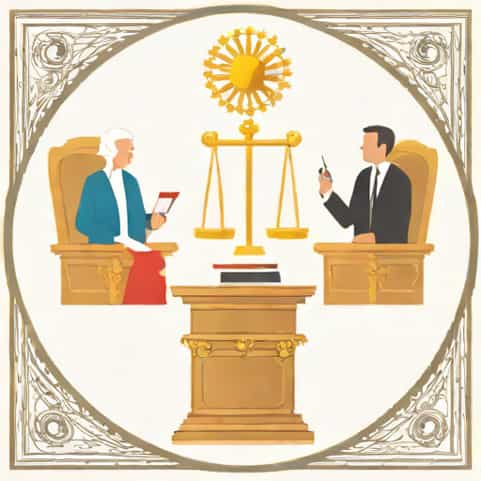
Among the most influential ideas in political philosophy, the concept of separation of powers as developed by Montesquieu stands as a cornerstone of modern democratic governance. It was Montesquieu’s analysis of how power should be distributed and controlled that shaped not only European thought but also the foundations of the United States Constitution and many other governments worldwide. His ideas continue to be studied because they address a timeless issue how to prevent tyranny while ensuring effective government. Understanding separation of powers Montesquieu proposed helps us see the balance between liberty, law, and authority in society.
Montesquieu and His Work
Charles-Louis de Secondat, better known as Montesquieu, was an eighteenth-century French philosopher and political thinker. His most famous work,The Spirit of the Laws, published in 1748, became one of the most influential texts in political theory. In this book, Montesquieu explored how laws, institutions, and governments are shaped by history, geography, and culture. One of his key contributions was the idea that governmental power must be divided into distinct branches to prevent abuse.
The Principle of Separation of Powers
At the heart of Montesquieu’s philosophy was the conviction that concentrated power leads to corruption and oppression. To avoid tyranny, power must not rest in one person or institution but should instead be divided among different branches of government. Montesquieu believed that by separating power, each branch could act as a check on the others, preserving liberty and justice.
The Three Branches
- Legislative PowerResponsible for making laws. According to Montesquieu, this body should represent the people and create rules for society’s functioning.
- Executive PowerCharged with enforcing laws and managing day-to-day governance, such as foreign policy and defense.
- Judicial PowerEntrusted with interpreting laws and ensuring justice, resolving disputes impartially between individuals and the state.
Checks and Balances
The separation of powers Montesquieu described was not only about dividing authority but also about balancing it. If one branch grew too powerful, it could threaten freedom. Therefore, each branch needed mechanisms to limit the others. This interdependence created a system of checks and balances that ensured stability while preventing abuse. For example, while the legislature could pass laws, the judiciary could review them, and the executive had the power to veto or enforce selectively within legal bounds.
Influence on Modern Democracies
Montesquieu’s theories deeply influenced the design of democratic governments, particularly in the United States. The framers of the U.S. Constitution borrowed heavily from his writings when establishing the division of powers between Congress, the President, and the Supreme Court. His work also shaped constitutional law in France, Latin America, and other nations adopting democratic systems. The principle continues to serve as a foundation for constitutional democracies around the world.
United States Example
In the American system, the legislative branch is Congress, the executive branch is led by the President, and the judicial branch is the Supreme Court and lower courts. The design explicitly reflects Montesquieu’s philosophy, with each branch empowered but limited by the others. This structure has endured for centuries, demonstrating the practicality of separation of powers Montesquieu envisioned.
Other Global Examples
Many countries, from India to Brazil, incorporate similar principles, though with unique adaptations suited to local culture and governance. Parliamentary systems often combine aspects of executive and legislative functions but still respect the principle that powers must not be centralized unchecked.
Criticism and Limitations
While Montesquieu’s idea of separation of powers is highly respected, it has also faced criticism. Some argue that too much division can create gridlock, preventing governments from acting decisively in times of crisis. Others suggest that power can still become unbalanced even in a three-branch system, especially when one branch dominates politically or financially. Nonetheless, the underlying principle remains valuable as a safeguard against absolute rule.
Montesquieu’s Historical Context
It is essential to recognize that Montesquieu developed his ideas during the Age of Enlightenment, a period of intellectual awakening that questioned absolute monarchy and traditional authority. France at the time was dominated by centralized royal power. Montesquieu’s vision offered an alternative, proposing liberty through balanced governance. His ideas resonated with revolutionaries and reformers who sought a more just and accountable political order.
Practical Application of Separation of Powers
The separation of powers Montesquieu introduced is not just theoretical; it has practical implications in daily governance. In modern states, this principle appears in the form of
- Independent courts capable of challenging unconstitutional laws.
- Legislative oversight of executive decisions.
- Executive veto powers balanced by legislative overrides.
- Public accountability through elections and judicial reviews.
Importance for Liberty
Montesquieu stressed that liberty is not the freedom to do whatever one wants but the assurance that laws are fair and applied equally. Separation of powers guarantees this liberty by ensuring that no authority becomes absolute. Citizens gain protection from arbitrary rule, while governments remain accountable and transparent.
Modern Relevance
Even today, debates about separation of powers remain vital. Issues such as executive overreach, judicial independence, and legislative gridlock highlight the ongoing challenge of balancing power. Montesquieu’s ideas remind us that liberty requires constant vigilance and that institutions must adapt while preserving the principle of divided authority.
Lessons for Today
Montesquieu’s separation of powers teaches several important lessons relevant for modern societies
- Power must be distributed to prevent abuse.
- Institutions must check each other for accountability.
- Liberty depends on the balance between governance and restraint.
- Constitutions should evolve but remain grounded in fundamental principles.
Conclusion on Separation of Powers Montesquieu
The separation of powers Montesquieu outlined continues to shape political systems centuries after he first articulated it. His vision of dividing legislative, executive, and judicial functions into separate but interdependent branches remains a guiding principle for democratic governance. Though challenges and criticisms exist, the essence of his theory endures because it provides one of the clearest safeguards against tyranny. By studying Montesquieu’s ideas, societies better understand how to balance authority with liberty, ensuring that governments serve the people rather than control them.