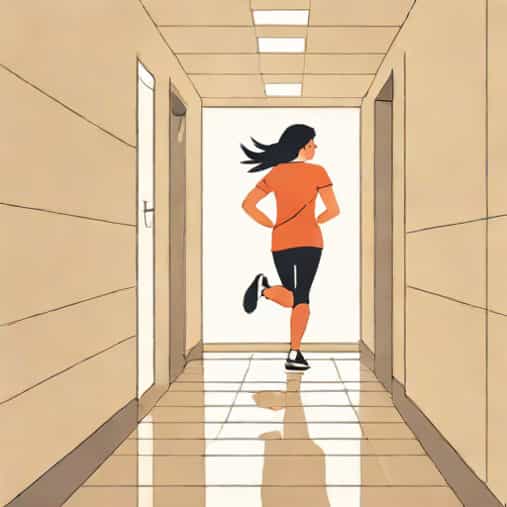
She was running down the hallway crazily, her footsteps echoing against the narrow walls as if the building itself was chasing her forward. The moment felt stretched and compressed at the same time, filled with urgency, fear, and a strange clarity that only appears in moments of intense emotion. This simple image captures something deeply human movement driven by instinct, emotion spilling into action, and a story unfolding in a confined space that somehow feels endless.
The Power of a Single Image
The phrase she was running down the hallway crazily instantly creates motion and tension. A hallway is a limited space, often associated with transition, waiting, or uncertainty. When someone runs through it in a frantic way, the ordinary setting becomes dramatic.
This image works because it invites the reader to ask questions. Why is she running? What is she escaping from, or what is she running toward? The lack of immediate answers pulls the audience deeper into the moment.
Why Hallways Create Emotional Impact
Hallways appear frequently in stories, films, and dreams. They are places between destinations, where decisions are not yet finalized. Running through a hallway suggests urgency without resolution.
When someone runs crazily through such a space, it reflects emotional imbalance, panic, or overwhelming pressure. The setting amplifies the character’s internal state.
Interpreting Crazily in Context
The word crazily does not always mean insanity. In many narratives, it describes behavior driven by extreme emotion rather than logic. She may be frightened, desperate, or consumed by adrenaline.
This choice of word adds intensity and unpredictability. The reader imagines uneven steps, rapid breathing, and thoughts racing faster than her body can keep up.
Emotion Behind the Movement
Running crazily often comes from a breaking point. It can symbolize fear, urgency, or even excitement. The body reacts before the mind fully processes the situation.
In storytelling, this kind of action reveals more about a character than calm dialogue ever could.
A Moment of Crisis
When she was running down the hallway crazily, it likely marked a moment of crisis. Something had changed, something irreversible. Crisis moments strip characters down to their most honest selves.
In real life, people rarely behave gracefully during emergencies. Panic disrupts order, and instincts take control. This realism makes the scene believable and relatable.
Physical Reactions to Stress
During intense stress, the human body releases adrenaline. This can cause rapid movement, tunnel vision, and a sense of detachment from surroundings.
- Heart rate increases
- Breathing becomes shallow
- Focus narrows to immediate survival
- Rational thinking is delayed
These reactions explain why her running appears frantic rather than controlled.
The Hallway as a Metaphor
Beyond the physical setting, the hallway can represent a mental or emotional passage. She may be moving between who she was and who she is about to become.
Running through it crazily suggests resistance to change or a desperate push toward it. Either way, the hallway becomes symbolic rather than merely architectural.
Transition and Transformation
Many life moments feel like hallways. We are no longer in the past, but we have not yet arrived at the future. In such moments, emotions often feel overwhelming.
Her frantic movement reflects the discomfort of being in between, unsure of what waits at the end.
Fear as a Driving Force
Fear is one of the strongest motivators for sudden action. If she was running down the hallway crazily, fear may have been close behind her, real or imagined.
Fear does not always need a visible threat. Sometimes it comes from anticipation, memory, or internal conflict.
Visible and Invisible Threats
The threat she senses may not be a person or object. It could be news she just received, a realization she cannot ignore, or a decision she regrets delaying.
This ambiguity makes the moment powerful, as readers project their own fears onto the scene.
The Sound of Footsteps
Footsteps echoing in a hallway add another layer to the image. Sound reinforces isolation and urgency. Each step announces her presence, making it impossible to hide.
The noise can heighten anxiety, especially if she is trying to escape unnoticed.
Silence Versus Noise
In contrast to silence, loud footsteps feel chaotic. They suggest loss of control and desperation.
The hallway amplifies this effect, turning movement into something unavoidable and exposed.
Psychological Interpretation
From a psychological perspective, running crazily can represent an internal struggle. She may be fleeing from her own thoughts or emotions.
In this sense, the hallway exists within her mind, a narrow space filled with pressure and urgency.
Fight or Flight Response
The body’s fight or flight response often manifests as sudden movement. When fighting feels impossible, flight becomes the natural choice.
Her run is not weakness; it is survival.
Relatability and Human Experience
Most people have experienced moments where they wanted to run, physically or emotionally. Stressful deadlines, sudden loss, or overwhelming responsibility can trigger similar sensations.
This is why the image resonates. It reflects a universal response to feeling trapped.
Why Readers Connect
Readers see themselves in her movement. They remember times when they felt rushed, panicked, or driven by emotion rather than reason.
The hallway becomes a shared space of memory and feeling.
What Happens at the End of the Hallway
The most compelling part of this moment is what remains unseen. The end of the hallway holds possibility, danger, or relief.
Her running suggests that whatever waits there matters deeply.
Open-Ended Tension
By focusing on movement rather than outcome, the moment stays alive. The story does not end with her run; it begins there.
This open-ended tension keeps the reader engaged.
She was running down the hallway crazily, and in that single action lies fear, urgency, transformation, and humanity. The image captures a moment when emotion overpowers control and instinct takes the lead. Whether viewed as a physical escape or a symbolic journey, it reflects a universal experience of being pushed to the edge. Through the confined space of a hallway and the wild energy of her movement, the scene reminds us that sometimes the most powerful stories begin not with answers, but with motion.