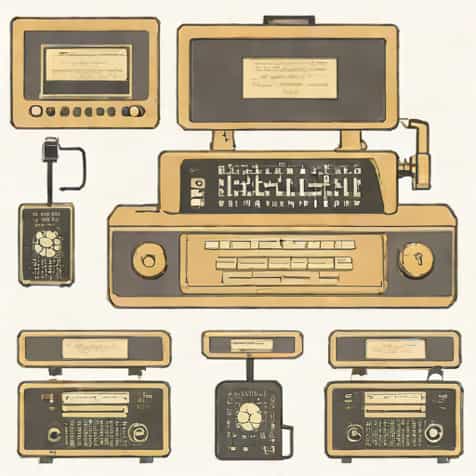
The Hollerith census machine, developed by Herman Hollerith in the late 19th century, revolutionized the way large-scale data processing was conducted. Before its invention, census data was manually tabulated, a process that was time-consuming, prone to error, and required a massive workforce. The Hollerith machine utilized punched cards to store information, allowing for automated counting, sorting, and tabulation. This innovation not only accelerated the processing of census data but also laid the foundation for modern computing and data management systems. The uses of the Hollerith census machine extend beyond national censuses, influencing various sectors that require efficient data handling, statistical analysis, and record-keeping. Understanding the applications and impact of this historic technology sheds light on how it shaped contemporary methods of information processing and decision-making.
Primary Uses in Census Operations
The most prominent use of the Hollerith census machine was, unsurprisingly, in national censuses. Governments worldwide relied on this machine to process vast amounts of demographic information efficiently. By encoding data such as age, gender, occupation, and geographic location onto punched cards, the machine enabled rapid compilation and tabulation of census results. This capability dramatically reduced the time required to analyze census data, ensuring more accurate population statistics and better-informed policy decisions.
Data Tabulation and Analysis
Before the introduction of the Hollerith machine, tabulating millions of census records could take years. With punched card technology, each card represented an individual record, and the machine could quickly count and sort these records based on specific characteristics. This innovation allowed statisticians and policymakers to analyze population trends, assess economic conditions, and allocate resources more effectively. The accuracy and speed of the machine made it possible to produce timely reports that informed decisions on public health, education, and infrastructure development.
Reducing Human Error
Manual data entry and calculation were highly susceptible to errors, which could compromise the accuracy of census results. The Hollerith census machine minimized human intervention in processing, reducing mistakes in counting, summing, and categorizing data. This reliability increased confidence in census outcomes, providing governments and researchers with trustworthy demographic statistics that could guide economic planning, taxation policies, and social programs.
Applications Beyond National Censuses
While initially designed for census operations, the Hollerith machine found applications in other areas where large-scale data processing was required. Businesses, insurance companies, and financial institutions recognized the value of automating data handling to improve efficiency and decision-making.
Business and Industrial Uses
Companies dealing with payroll, inventory management, and customer records adapted the punched card system to streamline operations. For payroll, the machine could quickly calculate salaries, taxes, and deductions for hundreds or thousands of employees. Inventory tracking was also simplified, as the machine could count, sort, and update stock records with minimal manual effort. These applications saved time, reduced labor costs, and improved organizational accuracy.
Insurance and Financial Institutions
Insurance companies utilized Hollerith machines to process policyholder information, calculate premiums, and manage claims efficiently. Similarly, banks employed the technology to handle large volumes of account data, facilitating faster transaction processing and record maintenance. By automating these tasks, institutions could serve clients more effectively while minimizing administrative overhead and human error.
Statistical Research and Government Planning
Beyond administrative functions, the Hollerith census machine played a significant role in statistical research and government planning. Researchers could analyze trends in employment, migration, and urbanization by processing large datasets quickly. Governments used the machine to predict resource needs, plan public services, and design policies targeting population growth, health, and education. The machine’s ability to sort and cross-tabulate data allowed for complex analyses that were previously impractical due to manual limitations.
Public Health Applications
In public health, accurate population data is crucial for planning vaccination campaigns, controlling epidemics, and allocating healthcare resources. The Hollerith machine enabled rapid analysis of health-related statistics collected during censuses or surveys, helping authorities respond to public health challenges more effectively. By understanding population demographics and distribution, health officials could implement targeted interventions and monitor outcomes efficiently.
Urban Planning and Infrastructure
Urban planners relied on demographic data processed by Hollerith machines to design cities, roads, and public facilities. Information on population density, housing conditions, and employment patterns helped guide decisions on where to build schools, hospitals, and transportation networks. The speed and accuracy of data processing allowed planners to adjust projects based on up-to-date information, improving the efficiency and sustainability of urban development.
Legacy and Influence on Modern Computing
The Hollerith census machine is often regarded as a precursor to modern computers. Its use of punched cards, electromechanical sorting, and tabulating technology laid the groundwork for digital data processing. The principles established by Hollerith influenced the development of early computers, programming, and database management systems, demonstrating the machine’s far-reaching impact beyond its original purpose.
Innovation in Data Storage
Punched cards introduced a standardized method for storing and encoding information. This innovation made it possible to preserve large amounts of data in a structured format, enabling automated reading and processing. Modern database systems and electronic data storage owe much to the concepts pioneered by Hollerith technology, illustrating how early inventions shaped contemporary information systems.
Automation and Efficiency
The Hollerith machine demonstrated the potential of automation to replace repetitive and labor-intensive tasks. By mechanizing counting, sorting, and tabulating, organizations could process information faster and more accurately. This concept of automation has become central to computing, manufacturing, and service industries today, highlighting the lasting relevance of Hollerith’s invention.
Educational and Historical Significance
The Hollerith census machine also holds educational and historical importance. It serves as a case study in the evolution of data processing, illustrating how technology can transform administrative, research, and business operations. Students of computer science, history, and statistics often study the machine to understand the origins of computing and the practical challenges it addressed in handling large datasets.
Museum Exhibits and Demonstrations
Many museums around the world feature Hollerith machines in exhibits on computing history. Demonstrations of punched card systems provide insight into early data processing techniques, helping the public appreciate the ingenuity of past technologies. These exhibits also highlight the social and economic impacts of automation, showing how one invention can influence multiple sectors over time.
The Hollerith census machine revolutionized data processing by introducing punched card technology and automated tabulation. Its primary uses in national censuses enabled rapid and accurate demographic analysis, while applications in business, finance, research, and public planning demonstrated its versatility. Beyond practical uses, the machine’s legacy continues in modern computing, data management, and automation technologies. By studying the Hollerith machine, we gain a deeper understanding of the historical evolution of data processing, the benefits of automation, and the foundational innovations that paved the way for today’s digital world.