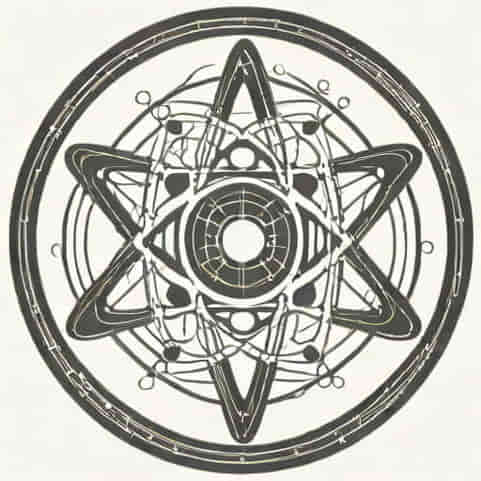
Visualizing and drawing the atom according to Democritus is a fascinating exercise in understanding the origins of atomic theory. Democritus, an ancient Greek philosopher who lived around 460-370 BCE, was one of the first thinkers to propose that matter is composed of small, indivisible ptopics called atoms. Although he lacked modern scientific tools and experimental methods, his ideas laid the conceptual foundation for the study of matter that would evolve over millennia. Exploring how Democritus envisioned the atom allows students, educators, and enthusiasts to appreciate the historical development of atomic theory and to practice conceptual visualization in science.
Who Was Democritus?
Democritus was a Greek philosopher who studied under Leucippus and developed a detailed philosophical framework around the concept of atoms. He believed that everything in the universe is composed of tiny, indivisible, and indestructible ptopics called atoms, moving through empty space, which he called the void. His atomic theory aimed to explain the diversity of materials and natural phenomena without invoking supernatural explanations. Democritus’ atom was conceptual rather than experimental, meaning it was a theoretical idea rather than one based on observation or laboratory work.
Key Principles of Democritus’ Atom
- IndivisibilityAtoms are the smallest units of matter and cannot be divided further.
- Material CompositionAll matter consists of combinations of different types of atoms.
- Variety in Shape and SizeAtoms differ in shape, size, and arrangement, which explains the diversity of materials.
- Empty Space (Void)Atoms move freely in a void, and the interactions between atoms create physical phenomena.
Democritus’ vision of atoms was purely philosophical, yet it anticipated some elements of modern atomic theory, such as the idea that matter is composed of fundamental units.
Visualizing the Atom According to Democritus
Since Democritus lived more than 2,000 years ago, he did not provide diagrams of atoms as modern scientists do. Instead, he described them conceptually. To visualize his atom today, we can imagine it as a solid, indivisible ptopic, often depicted as a tiny sphere or point. Unlike modern atoms, which have subatomic structures like protons, neutrons, and electrons, Democritus’ atom was uniform and simple, lacking internal components.
Steps to Draw Democritus’ Atom
When tasked with visualizing or drawing the atom according to Democritus, follow these steps
- Start with a small circle to represent the indivisible ptopic.
- Label it Atom to indicate that it is the smallest unit of matter.
- Optionally, draw multiple atoms in different arrangements to show that materials are composed of many atoms combined in various ways.
- Leave space around the atoms to represent the void in which they move.
This simplified visualization captures Democritus’ ideas about matter atoms are solid, indivisible, and exist within empty space.
Conceptual Representation of Atom Shapes
Democritus also proposed that atoms have different shapes, which contribute to the properties of matter. For example, sharp, jagged atoms might form solid or hard materials, while smooth, round atoms might form liquids. To incorporate this into a drawing
- Draw different shapes for atoms some triangular, some circular, and some irregular.
- Group atoms with similar shapes to indicate how they combine to form substances.
- Use dotted lines or spacing to suggest movement through the void.
This approach helps students and enthusiasts understand the diversity of matter as explained by Democritus without relying on modern atomic models.
Comparing Democritus’ Atom to Modern Atomic Theory
While Democritus’ atom was a philosophical concept, modern atomic theory is based on experimental evidence. Modern atoms consist of a nucleus containing protons and neutrons, with electrons orbiting around it. Despite the differences, Democritus’ idea shares some similarities with contemporary understanding
- Atoms are fundamental building blocks of matter.
- Different arrangements of atoms create different substances.
- Atoms move in space and interact to form matter.
By comparing his ideas to modern theory, we can appreciate the foresight of early philosophers and the evolution of scientific thought.
Educational Importance of Drawing Democritus’ Atom
Visualizing and drawing atoms according to Democritus is not only a historical exercise but also a valuable educational tool. It encourages conceptual thinking, helps students understand the development of scientific ideas, and emphasizes that science is built over centuries through observation, reasoning, and refinement. Students can practice differentiating between conceptual models and experimental models, recognizing that Democritus’ atom is a theoretical simplification rather than an accurate physical depiction.
Applications in Learning and Science
Drawing Democritus’ atom can be applied in classrooms, science projects, and historical studies of science philosophy. It helps in
- Teaching the history of scientific thought and early atomic theory.
- Illustrating the difference between philosophical models and experimental science.
- Encouraging students to think critically about abstract concepts and their practical implications.
- Connecting ancient ideas to modern scientific discoveries in chemistry and physics.
Using visual aids to complement textual explanations makes it easier for learners to grasp the fundamental concept of matter as composed of indivisible units.
Visualizing and drawing the atom according to Democritus allows us to explore the origins of atomic theory and understand how early philosophers conceptualized the nature of matter. His atoms were indivisible, solid, and moved in a void, differing in shape and size to explain the variety of substances in the world. By drawing simple circles or differently shaped ptopics, students can replicate his ideas and gain insight into the philosophical foundations of science. While modern atomic theory has evolved through experimental discoveries and subatomic understanding, Democritus’ vision remains an important step in the development of scientific thinking. Practicing visualization and drawing of Democritus’ atom enhances comprehension of both historical concepts and the fundamental principles of matter, bridging the gap between ancient philosophy and modern science.